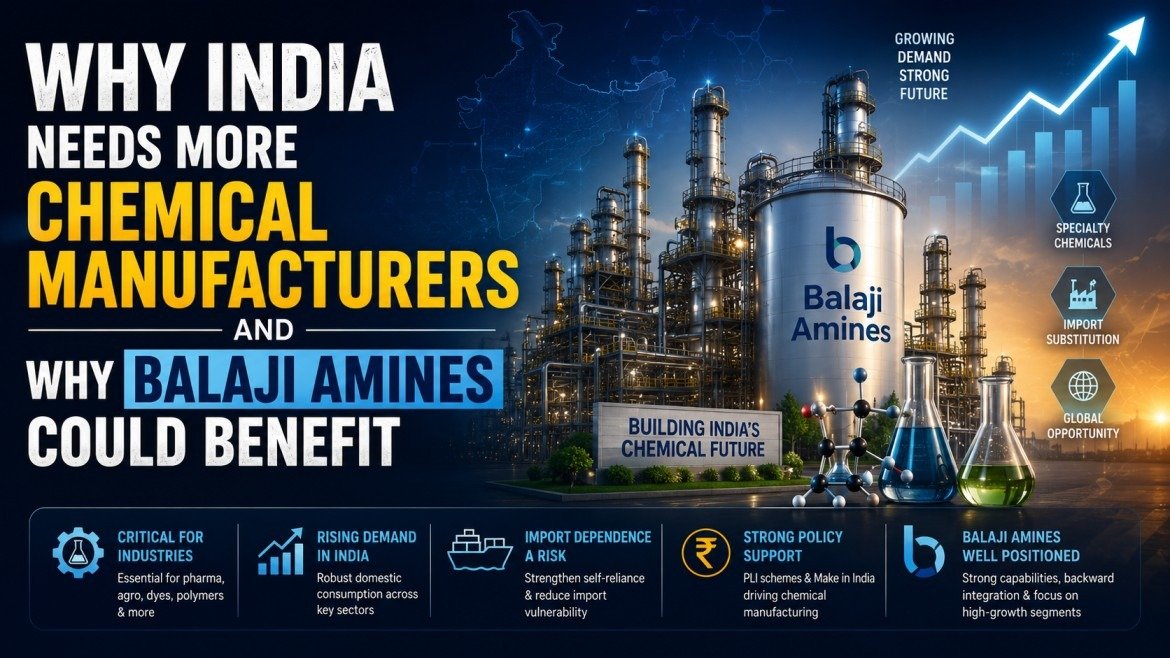
Chemicals are present in everything from the drugs we keep at home to the cleaning agents we use to power cars and other industrial products.
Thank you for reading this post, don't forget to subscribe!Nevertheless, a sizable proportion of the chemicals that are consumed in India comes from overseas.
This presents a peculiar scenario for one of the largest producers of chemicals in the world. India is considered to be a major producer of chemicals, but the production of chemicals is not up to speed with the fast-growing demands of India. The result is that there is a dependence on imports of chemicals.
To Indian manufacturers of chemicals, this is an opportunity.
India’s Rising Chemical Imports
India imports about $71 billion worth of chemicals every year. The chemical trade deficit in the country has grown rapidly, increasing from around $17 billion in 2020 to almost $31–32 billion now.
Up to 30% of the total chemical demand of India is still satisfied through imports. In certain categories, the import reliance is much greater, with more than 60% of petrochemical feedstocks and about 45% of petrochemical intermediates being imported into the country.
The problem is not limited only to niche products.
India continues to depend on foreign sources in many stages of the chemical value chain, from commodity chemicals, specialty chemicals, and intermediates to performance materials that are needed in the manufacture of pharmaceuticals, agrochemicals, water treatment, the electronics industry, the automotive industry, and others.
This is obviously a structural opportunity for local producers.
Unlike targeting markets from scratch, Indian chemical firms can focus on sectors where the demand already exists, but it is being served by foreign producers.
China+1 Is Redefining the Global Chemical Manufacturing Chain
For several years now, China has been a powerful player in the world’s chemical manufacturing. The sheer size of the company, the developed supply chain, infrastructure, and low costs of production ensured that China was the number one manufacturer choice for all customers.
However, the situation has changed.
The high cost of labour, strict environmental regulations, political issues, and supply chain disruptions during the pandemic period have driven many companies to look for alternative manufacturing locations to China.
And thus, the new China+1 strategy emerged, implying development of manufacturing relations beyond the borders of China.
It is especially relevant for specialty chemicals.
Customers no longer judge manufacturers based on cost only; they need consistent quality, stable supplies, good technical knowledge, regulatory compliance, and the ability to create customized solutions.
This makes India a promising player in the industry.
Reasons why India can be a Major Center for Chemical Manufacture
India has some reasons why it can expand its chemical manufacturing industry.
It has a big and growing market at home, process engineering expertise, a growing manufacturing system, and technical manpower.
But more significantly, India is currently part of many global chemical value chains. Hence, it has a strong base from which to grow and does not have to start an industry from scratch.
The potential might be even greater if global firms shift their sourcing from China.
Based on industrial estimates, there is potential for India to double its specialty chemical industry if about 20% of global specialty chemical sourcing shifts from China.
For those manufacturers that will meet international standards of quality and reliability, this would result in long-term growth.
Policy Support Enhances Opportunities
Policy support is yet another factor playing in favor of India.
There are policies like Make in India and Atmanirbhar Bharat that are intended to promote domestic manufacturing, eliminate the need for imports, and increase value additions in the country.
The government has also allowed 100 percent FDI in the chemical industry through the automatic route. PCPIRs have been created to help build integrated manufacturing systems, while PLIs have helped sectors heavily reliant on chemicals such as pharmaceuticals, electronics, and batteries.
There have also been incentives from state governments intended to attract investments in manufacturing.
All these are making India more conducive for those companies that wish to make investments in domestic chemical manufacturing.
But More Capacity Is Not the Only Requirement
However, there is one very important point that needs to be made clear to investors.
It is not enough for India to increase its manufacturing capacity of chemical substances. India must increase its manufacturing capability.
The production of a commodity chemical substance is a totally different matter than manufacturing a specialty chemical substance, which India imports today.
Specialty chemicals manufactured overseas require a lot of process development, manufacturing capability, rigorous quality controls, customer qualification, and various approvals. Customer qualification could take several years, especially if the chemical substance is used in critical pharmaceutical, industrial, or electronic applications.
And this is a huge barrier to entry.
One can simply establish a facility and produce the chemical, but no one will buy it.
Climbing the Chemical Value Chain
The most attractive opportunity, therefore, may not be in the production of more low-value chemicals. Rather, it is in climbing up the value chain to high-value, more complex products.
Firms that can produce intermediates, create specialised derivatives, achieve improved yields, optimize processes, and deliver customised solutions would be able to derive greater value from the same chemical ecosystem.
It would even help to build customer relationships.
Once a firm has been established as a supplier of a specialized product, it is not easy to substitute the product by sourcing it from some other supplier of the standard commodity chemical.
This could prove to be a competitive advantage and help in deriving higher margins.
THE INDIAN AMINES INDUSTRY: WHERE DOES BALAJI FIT?
Before understanding Balaji Amines, we first need to understand the industry it operates in.
Every company in the industry specializes in a particular chemistry platform, and that specialization shapes its competitive advantages, customers, and long-term growth potential.
For Balaji Amines, that platform is exactly what its name suggests: amines.
Although the term sounds technical, amines are among the most important building blocks in the chemical industry. Produced from feedstocks such as methanol, ethanol, and ammonia, they are used to manufacture life-saving medicines, crop protection chemicals, paints, resins, water treatment chemicals, personal care products, and countless industrial chemicals. Whether it is a diabetes medicine like Metformin, a pesticide, or a chemical used to purify drinking water, there is a good chance an amine played a role in its production.
What makes this industry interesting is not the basic molecule itself, but what companies do with it.
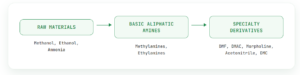
The journey starts with basic amines such as methylamines and ethylamines. Some manufacturers simply sell these products. Others use them as raw materials to produce higher value specialty chemicals such as DMF, DMAC, Morpholine, Acetonitrile, and DMC.
That difference changes the economics of the business.
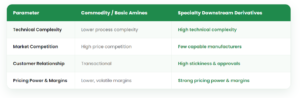
Basic amines are largely commodity products where price drives competition. Specialty chemicals require greater technical expertise, tighter quality control, and lengthy customer approvals. As a result, they generally enjoy better margins, fewer competitors, and stronger customer relationships.
Instead of treating methylamines as the final product, the company increasingly uses them to manufacture higher value specialty chemicals. Every additional processing step allows it to extract more value from the same feedstock, a strategy that has shaped the business over the years.
India has several well-known chemical companies, but each has built expertise around a different chemistry platform. Alkyl Amines focuses on aliphatic amines, Jubilant Ingrevia on pyridine chemistry and acetyl chains, Laxmi Organics on acetyl intermediates and fluorospecialty chemicals, while Aarti Industries is known for benzene based chemistry and nitration and chlorination value chains.
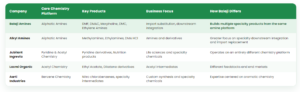
Balaji has chosen a different path.
Rather than diversifying across multiple chemistries, it has steadily deepened its expertise in aliphatic amines and the specialty chemicals derived from them. This focused approach has helped the company strengthen its technical capabilities, improve manufacturing efficiency, and move into increasingly complex products.
Today, the company manufactures more than 40 products, serving industries such as pharmaceuticals, agrochemicals, electronics, water treatment, and industrial chemicals. It is also the sole or one of the leading domestic manufacturers of products such as DMF, DMAC, and Morpholine, while specialty chemicals and downstream derivatives now contribute a significant share of its business.
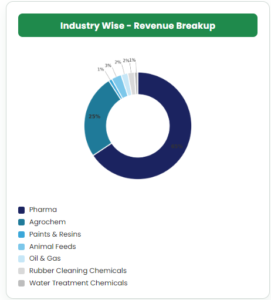
As you study Balaji, three themes appear repeatedly. The first is integration, where basic chemicals are consumed internally instead of being sold. The second is import substitution, where the company develops domestic alternatives to imported products. The third is moving up the value chain, using the same chemistry platform to manufacture increasingly specialized products.

The next question is how has the company executed this strategy over the years and turned it into one of India’s most integrated import substitution platforms.
HOW BALAJI BUILT ITS BUSINESS?
When most manufacturing companies think about growth, Balaji Amines chose a different approach.
Which important chemical is India importing today, and can we manufacture it ourselves?
That question has shaped almost every major investment the company has made.
Management has often described its philosophy simply: every product introduced by the company was once imported into India, and every new plant was built to make the country a little more self-reliant.
Rather than chasing short term demand or entering unrelated businesses, Balaji has followed a consistent strategy. It identifies an imported product, develops the technology to manufacture it, scales production, and then uses that capability to enter the next opportunity.
Viewed individually, these projects look like ordinary capacity expansions. Viewed together, they reveal a company patiently building an integrated import substitution platform.

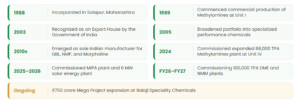
Founded in 1988 by Ande Prathap Reddy, Balaji began commercial production of methylamines at its Solapur facility in 1989. Instead of repeatedly expanding the same products, it steadily built new capabilities.
Its journey can be understood in three phases. The first was establishing a foundation in basic aliphatic amines such as methylamines and ethylamines. The second was moving further up the value chain by converting these into downstream products like DMF and DMAC, capturing greater value while reducing dependence on commodity markets. The third phase, where the company is today, focuses on specialty chemicals such as Electronic Grade DMC, Dimethyl Ether, N Methyl Morpholine, and new products through Balaji Speciality Chemicals.
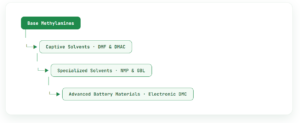
Each phase strengthened the previous one rather than replacing it.
A timeline illustrating this evolution is shown below.
One of the clearest indicators of management quality is how it allocates capital, and Balaji has remained disciplined throughout its journey.
The standalone business is debt free, with major expansions including Dimethyl Ether, Acetonitrile, and N Methyl Morpholine largely funded through internal cash generation. Even the ongoing ₹750 crore expansion at Balaji Speciality Chemicals relies mostly on internal accruals.
Instead of pursuing acquisitions, the company has consistently invested in expanding its own manufacturing platform and developing technology in house. That approach may be slower, but every investment builds on capabilities the company already possesses.
The same thinking extends to manufacturing.
Rather than selling most of its methylamines, Balaji consumes nearly 80% internally to produce downstream products. This allows the company to earn value at multiple stages of production while reducing its exposure to commodity cycles.
It has also invested in continuous process plants, a 6 MW solar power plant that supplies around 30% of its electricity needs, and Zero Liquid Discharge systems that improve operational efficiency and support environmental compliance.
Perhaps the company’s biggest differentiator is its focus on indigenous technology.
While many chemical manufacturers rely on licensed processes, Balaji develops its own manufacturing technology through in house research and development. This gives it greater control over plant design, process improvements, catalyst optimization, and future expansion without paying royalties or depending on external licensors.
More importantly, research is directly tied to strategy. The company identifies chemicals that India imports, develops the manufacturing process internally, validates it through pilot testing, and then scales it into commercial production.
The more you study Balaji, the clearer the pattern becomes.
It starts with a basic molecule, develops the expertise to manufacture it efficiently, converts it into higher value specialty products, and reinvests the resulting cash flows into the next phase of growth. Each expansion strengthens the manufacturing platform, deepens customer relationships, and creates opportunities to enter more complex chemistries.
In other words, every project makes the next one easier.
Building capabilities is only one part of the story. The real test is whether those capabilities can be translated into products that solve genuine industry problems while replacing imports at scale.
The natural question then becomes: Which products has this strategy produced, and why were those molecules chosen over hundreds of other possibilities?
TURNING CHEMISTRY INTO OPPORTUNITY
By now, a clear pattern begins to emerge.
Every successful product becomes another step towards reducing the country’s dependence on imports while expanding the company’s own capabilities.
Let’s look at how this strategy has played out across its key products.
Heavy solvents: DMF and DMAC
One of Balaji’s earliest success stories came through Dimethylformamide (DMF) and Dimethylacetamide (DMAC), two solvents widely used in pharmaceutical manufacturing, polyurethane processing, and synthetic fibers.
For years, India relied heavily on imports, particularly from Chinese manufacturers. Recognizing this gap, Balaji developed domestic manufacturing capacity, starting with a 30,000 MTPA DMF plant before expanding by another 30,000 MTPA as demand continued to grow. Today, it holds a near monopoly position of DMF in India.
What makes these products strategically important is not just their market size, which continues to grow at around 7% to 10% annually, but the way they fit into Balaji’s integrated manufacturing model. By using its own methylamines as feedstock, the company captures more value, improves supply reliability, and reduces its dependence on external suppliers.
Specialty solvents: Morpholine, NMP and Acetonitrile
After establishing itself in heavy solvents, Balaji moved into more specialized products.
Morpholine is used in water treatment, rubber processing, agrochemicals, and optical brighteners, while N-Methyl Pyrrolidone (NMP) is an important solvent for pharmaceuticals, agrochemicals, and electronics. Before domestic production began, both products were largely imported. Balaji developed its own manufacturing process and became the sole producer of Morpholine in India while emerging as one of the few domestic manufacturers of NMP.
The company followed a similar approach with Acetonitrile, a high purity solvent used extensively in pharmaceutical manufacturing and analytical laboratories. Since global supply largely depended on acrylonitrile production, availability was often unpredictable. Balaji addressed this by developing its own production route using acetic acid and ammonia and expanded capacity to 18,000 MTPA, giving Indian pharmaceutical companies a dependable domestic source.
Supporting the energy transition
As India’s manufacturing landscape evolved, so did Balaji’s product portfolio.
The company entered Dimethyl Carbonate (DMC), a green chemical used in polycarbonate plastics and, more importantly, in lithium-ion battery electrolytes for electric vehicles. With a 15,000 MTPA facility, Balaji became the only domestic manufacturer of DMC, replacing imports of a product that demands extremely high purity standards.
It also invested in a 100,000 MTPA Dimethyl Ether (DME) plant. DME is used in aerosol sprays and can also serve as a cleaner substitute for LPG in industrial applications. As India looks to strengthen its energy security, DME represents another example of Balaji identifying a large import dependent market and creating domestic manufacturing capacity.
Expanding into advanced specialty chemicals
Balaji’s ambitions extend well beyond solvents.
Through its subsidiary, Balaji Specialty Chemicals Limited (BSCL), the company entered the ethylene amines business by establishing a 30,000 MTPA greenfield facility. Products such as Ethylene Diamine (EDA), Diethylene Triamine (DETA), Piperazine, and Aminoethyl Ethanolamine (AEEA) are widely used in agrochemicals, epoxy resins, lubricant additives, and chelating agents.
Before BSCL, India depended almost entirely on imports for these products. Today, the company is the sole domestic manufacturer of this range. Its flexible production setup also allows it to adjust the output mix based on market conditions, improving profitability while serving domestic demand.
The Next Frontier: Cyanation Chemistry
The company’s largest bet is now taking shape.
Through BSCL, Balaji is investing around ₹750 crore to build a cyanation chemistry platform that includes Hydrogen Cyanide, Sodium Cyanide, EDTA, and related downstream products.
This is a significant opportunity. India imports around 50,000 MTPA of Sodium Cyanide alone, while these chemicals are essential for industries such as mining, agrochemicals, textiles, and water treatment.

Handling Hydrogen Cyanide requires specialized technology, strict safety standards, and complex environmental approvals, creating substantial barriers to entry. Once commissioned, management expects this platform to generate more than ₹1,000 crore of annual revenue, making it one of the most important growth drivers for the company.
Looking across Balaji’s product portfolio, a clear pattern emerges. The company has not entered unrelated businesses or chased the latest industry trend. Every major product builds on the same chemistry platform, serves an existing import dependent market, and creates opportunities to move further up the value chain. That raises an equally important question. Has this product strategy actually created a better business?
FROM COMMODITY CHEMICALS TO SPECIALTY PRODUCTS
Building more factories does not automatically create a better business.
In the chemical industry, a company can double its production capacity and still struggle if it continues to sell commodity chemicals, where competition is driven by price, raw material costs are volatile, and global supply cycles dominate.
Balaji Amines has deliberately moved away from that model.
Rather than producing larger volumes of the same chemicals, it has steadily increased the value extracted from every molecule that enters its plants.
This creates two clear advantages. It lowers transportation and handling costs by moving hazardous chemicals directly between adjacent plants, and it allows Balaji to earn value at multiple stages of production instead of generating a single margin from selling a basic amine.
The impact of this strategy is already visible.
Over time, Balaji has evolved from a producer of basic amines into a specialty chemical manufacturer. In FY26, Specialty Chemicals generated around ₹598 crore of revenue, followed by Amine Derivatives at ₹525 crore, while Aliphatic Amines contributed about ₹402 crore.
This shift is important because specialty chemicals typically command higher realizations, face lower competition, and deliver better profitability. As businesses such as Electronic Grade DMC, Dimethyl Ether, and cyanation chemistry scale up, the revenue mix is expected to move further towards higher value products.
Selling specialty chemicals also creates stronger customer relationships.
Customers in pharmaceuticals, agrochemicals, and electronics usually spend 6 to 18 months testing products, auditing facilities, and completing regulatory approvals before adding a supplier. Balaji’s REACH, WHO GMP, and ISO certifications support this process. Once approved, customers are less likely to switch suppliers, making demand more stable.
The integrated business model also makes Balaji more resilient during industry downturns. While margins on basic amines may fluctuate with commodity cycles, downstream specialty products often remain relatively stable. This has enabled the company to fund major projects such as Dimethyl Ether, Acetonitrile, and Methylamines while maintaining a debt free standalone balance sheet. The cash generated from these businesses has, in turn, financed newer specialty projects.
This is also what differentiates Balaji from its peers.
Many chemical companies have built expertise around different chemistry platforms. Balaji’s strength lies in taking the same amine molecule and repeatedly converting it into higher value solvents, specialty chemicals, and advanced intermediates. That deeper integration allows it to extract more value from the same raw material while strengthening its position in technically demanding markets.
Perhaps the most interesting aspect of the strategy is how each success reinforces the next. Every expansion in methylamine capacity provides feedstock for new downstream products. Every specialty chemical strengthens customer relationships and technical expertise. Every successful project generates cash that funds future growth.
These improvements did not happen overnight. They were built through a series of carefully chosen projects, each moving the company into a more specialized part of the chemical value chain. The biggest test of that strategy, however, is still unfolding through Balaji’s largest investment to date.
CAN THE ₹750 CRORE BET CHANGE THE ECONOMICS?
The company is investing around ₹750 crore in one of the largest projects in its history at MIDC Chincholi, Solapur. The project has also received Mega Project status from the Government of Maharashtra under its Packaged Scheme of Incentives.
Unlike earlier expansions, this investment is not about producing more of the same products. It is about entering entirely new chemistries.
The project includes Hydrogen Cyanide, Sodium Cyanide, EDTA, Disodium EDTA, Benzyl Cyanide, Phenylacetic Acid, and advanced polyamines such as Diethylene Triamine, Triethylene Tetramine, Piperazine, and Aminoethyl Ethanolamine. These products serve industries including gold mining, pharmaceuticals, agrochemicals, textiles, and water treatment, while many are still imported into India.
Handling chemicals such as Hydrogen Cyanide requires specialized technology, strict environmental compliance, and rigorous safety standards, creating significant barriers to entry.
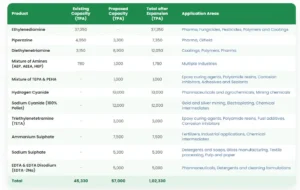
Management believes the project can generate minimum ₹1,000 crore of annual revenue once operations stabilize, bringing Balaji closer to its long-term aspiration of becoming a ₹3,000 crore revenue company.
More importantly, it marks the company’s entry into higher value specialty chemicals that are less exposed to commodity competition and better aligned with its long-term import substitution strategy.
Projects of this scale rarely transform a company overnight. New plants usually take time to stabilize, customers need to complete product approvals, and production volumes gradually increase over several quarters. That is why investors often focus as much on execution as on the project itself.
Large capital investments inevitably put temporary pressure on return ratios. Capital employed rises immediately, while earnings take time to catch up as new plants stabilize and customers complete product qualification. For Balaji, the current pressure on Return on Capital Employed (ROCE) should therefore be viewed as part of the project’s lifecycle.
As utilization improves, fixed costs are spread over larger production volumes, allowing operating leverage to improve profitability. Management believes mature utilization could support a recovery in ROCE to 17% to 20%.
Another distinguishing feature is the way Balaji has funded this expansion. While many peers relied heavily on debt, the company has continued to prioritize internal cash generation. The standalone business remains debt free, with only modest borrowings at the subsidiary level, providing greater financial flexibility during industry downturns.
Ultimately, the success of this investment will depend less on commissioning the plants and more on commercial execution. Investors should watch customer approvals, commercialization of products such as Sodium Cyanide and EDTA, the growing contribution of specialty chemicals to revenue, improving capacity utilization, and the recovery in ROCE as the new assets begin generating meaningful cash flows.
The ₹750 crore expansion is much more than another capacity addition. It is Balaji Amines’ biggest attempt yet to move further up the value chain. If executed successfully, it could reshape the company’s earnings profile and strengthen its position as one of India’s leading specialty chemical manufacturers.
The next question is equally important.
What could prevent this strategy from succeeding?
WHAT COULD GO WRONG?
So far, the story of Balaji Amines has been one of disciplined execution. The company has consistently identified products that India imports, developed the technology to manufacture them, and steadily moved up the value chain.
Every opportunity comes with uncertainty, and companies attempting large transformations usually face even greater execution risks. Balaji Amines is no exception.
But investing is not just about understanding what can go right. It is equally important to understand what could go wrong.
The biggest challenge comes from outside India.
China accounts for more than 60% of global chemical production capacity. When domestic demand weakens, Chinese manufacturers often export excess supply at aggressive prices. Products such as DMF, EDA, Morpholine, and NMP are particularly exposed to this competition. Although Balaji’s integrated manufacturing model helps lower conversion costs, prolonged oversupply can still pressure prices and profitability.
Execution is another key risk.
Balaji develops its manufacturing technology in house rather than relying on foreign process licenses. While this provides greater control, it also means the company bears the responsibility of scaling new processes from the laboratory to commercial production. Engineering challenges, lower than expected yields, or delays in stabilizing new plants could postpone commercialization and increase costs.
Even after a plant is commissioned, revenues take time to build. Pharmaceutical, agrochemical, and electronics customers typically spend months testing products before approving a new supplier. Electronic Grade DMC must meet extremely high purity standards, while products such as Dimethyl Ether require extensive customer trials. As a result, new facilities may initially operate at only 30% to 40% utilization, weighing on profitability.
The business is also exposed to fluctuations in raw material costs. Methanol and ammonia, largely imported from the Middle East, are vulnerable to geopolitical tensions and supply disruptions. Earlier in 2026, disruptions in West Asia tightened ammonia availability and temporarily affected production. If input costs rise sharply during periods of weak demand, passing those increases on to customers becomes difficult.
Regulatory oversight is another important consideration. Handling hazardous chemicals such as ammonia and Hydrogen Cyanide requires strict environmental and safety compliance. Regulatory scrutiny can also extend beyond manufacturing. A recent investigation into the labeling and licensing of Propylene Glycol created uncertainty even though the company clarified that it had sold only technical and food grade material while awaiting pharmaceutical approvals.
Demand from pharmaceuticals and agrochemicals is another variable. Inventory corrections or weaker global demand in these sectors can reduce orders for solvents and intermediates, affecting capacity utilization and earnings growth.
Large investments such as the BSCL project introduce additional execution risk. Capital employed increases immediately, but returns depend on timely commercialization and strong utilization.
This is why the market has become more cautious in recent years. The opportunity is still significant, but investors are waiting for clearer evidence that the company’s large investments will translate into stronger earnings and cash flows. Until then, slower profit growth, lower free cash flow during the expansion phase, margin fluctuations, and regulatory scrutiny are likely to remain key areas of focus.
Much will depend on how the next few years unfold. If the new plants achieve healthy utilization, the company maintains its technological advantage, and industry conditions remain supportive, Balaji could emerge much stronger. But if Chinese overcapacity persists, commercialization takes longer than expected, or regulatory issues become more frequent, the journey could prove more challenging.
Here’s a tighter, more investor-oriented rewrite at roughly 250 words, with a stronger narrative flow:
Has Balaji Amines Built India’s Next Import-Substitution Platform?
This story has ceased to be one about adding up the chemical capacity alone. During its journey over three decades, the company has been developing an integrated manufacturing capability from being just a supplier of amines to becoming a supplier of various speciality chemicals.
The reason behind this development is the fact that the true potential of India’s chemicals industry does not lie in making more chemicals but in substituting imports of difficult-to-manufacture-and-qualify chemicals.
As of today, Balaji Amines has over 3,93,600 MTPA of installed capacities in 40+ products. The company is the only, or one of the leading domestic producers of products like DMF, Morpholine, NMP, Electronic Grade DMC, and Ethylene Amines. The internal development of manufacturing process and debt-free standalone balance sheet represent yet another strategic edge of the company.
So far, it seems that the platform was built for the most part. The next task is its monetization.
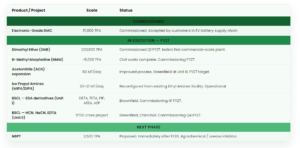
Execution will be the main parameter for investors. Utilization of capacities should be improved due to maturity of the newly established facilities, whereas specialty chemicals should keep growing further from the current ₹598 crore mark. The value of the product might help to raise margins and the return on invested capital, although the operating cash flows should still be sufficient for financing expansion without raising of the leverage.
There are risks, including pricing pressure from China, slow commissioning of plants, delay in client approvals and regulatory issues.
So far, Balaji Amines has managed to answer the first question – can it build an import-substitution platform?
Now comes the hard one – can it deliver profits, cash flows, and returns from it?
For any investor willing to gain an insight into the nature of business entities like Balaji Amines, Strategic Alpha offers a mentoring program with the aim of building knowledge about businesses and investment options. It enables the learner to develop an analytical model to understand such firms better.
If you need guidance on how to start your stock market journey, how much capital is enough to begin with, how to do smart investing, or how to take informed stock market decisions, you can join Strategic Alpha’s ‘The Conviction Club’. This is a membership program, especially curated to help investors become aware and knowledgeable about stock market trends, news, and technical aspects, so that they can become their own experts.
Our YouTube channel, weekly webinars, and digital resources available on the website can help you learn the basics of the stock market. For regular updates on trends, one-to-one sessions with experts, and detailed learning modules, you can join the Conviction Club, which is the online community of like-minded investors sharing knowledge and thoughts to grow together.
Subscribe to the Strategic Alpha Newsletter now to get the latest updates about weekly webinars.
Join Me On My Telegram Channel Where I Share Much More Value Adding Knowledge Of Investing/ Trading: Click Here
Also, Don’t Forget To Follow Us On Our Social Media Accounts:
Facebook: https://www.facebook.com/strategicalpha/
Instagram: https://www.instagram.com/strategicalpha/
Twitter: https://twitter.com/suyog_dhavan
YouTube: https://bit.ly/2IIqztO
Disclaimer: Strategic Alpha and Suyog Dhavan are not SEBI-registered investment advisor. The content provided is purely for educational purposes and should not be construed as financial or investment advice. Viewers are encouraged to conduct their own research or consult with a SEBI-registered professional before making any investment decisions.