

Investing is generally seen as an easy task in which you analyze a company, assess its value, recognize the opportunity, purchase the stock, and wait for the payoff. However, recognizing the correct thing to do and doing it when the money is at stake are entirely different matters.
Thank you for reading this post, don't forget to subscribe!Ultimately, the market is a game of psychology. It does not matter how well thought out your strategy is; you will not succeed if you do not have the discipline to follow through when the market goes against you. The bottom line is straightforward: while the strategy recognizes the opportunity, it is the discipline that decides whether you can seize it or not.
Paper trading will help you understand how the strategy works, but paper trading cannot fully prepare you for the experience of losing money yourself. When the stock that you researched so diligently loses another 20% in value, your research may not have changed, but your psychology definitely has. The immediate response might be to sell, simply because you do not want the feeling to continue any longer.
Investing is when the psychological part begins.
It is impossible to strip the emotions from the process, as it is human nature. It is imperative to find a way to avoid letting emotions control the decision-making process. The way to do this would be through position sizing, rules, and knowing what invalidates the case for buying the stock.
When FOMO Replaces Analysis
A similar psychological phenomenon exists in cases where prices are increasing.
For example, when you buy a stock thinking it is undervalued, it doubles in value, everyone talks about it, people around you start making profits, then the question subtly changes from:
“Is this stock worth buying at the current price?”
to
“Should I miss out on this?”
This phenomenon is called FOMO, fear of missing out.
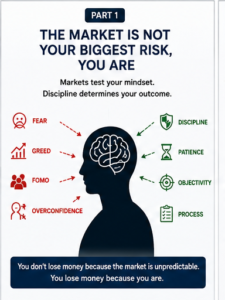
At this stage, the decision is no longer made purely on the grounds of valuation or business fundamentals. This decision becomes an emotional reaction to the actions of others.
The markets create a strong feeling of security in numbers. If everyone around owns the same stock, then the possibility of being wrong will be much more acceptable to them. However, consensus does not make investments safer. It just makes it socially acceptable to take the risks involved in the investment.
On the contrary, in the case where the stock decreases in value, people tend to place too much emphasis on recent price movements. Rising stocks appear to be good businesses, whereas falling ones become bad.
However, prices and business performance do not always coincide.
Don’t Judge an Investment Only by Its Outcome
One of the most significant psychological pitfalls lies in making conclusions about an investment decision based solely on its results.
A badly researched stock can grow. An extensively researched stock may drop. A positive result does not automatically indicate a good decision and vice versa.
Decisions have to be assessed based on information and investment thesis at the time of the decision.
Profitable investments can make people overly confident, and unsuccessful ones can drive investors to desperate acts. Both can take an investor away from the process leading to the decision-making.
And this is the reason why emotional detachment is so vital.
The goal is to analyze the company, not to get emotionally involved in the stock.
Sometimes it is better to do less, especially in reaction to the market.
Prices fluctuate, quarterly reports come, headlines change, and new ideas emerge daily. There is always something to act upon, although action does not necessarily equal progress.
Every superfluous decision means another chance for a mistake.
Why Being Early Feels Exactly Like Being Wrong
One of the most difficult aspects of deep value investing is that sometimes a good investment appears to be a bad investment for a long period of time.
You identify a solid company trading at a level significantly below your assessment of its fair value. Its balance sheet is solid; the company has a credible way out of its problems; the valuation provides a margin of safety.
- You invest in the stock.
- And then the stock goes down.
- Again and again and again.
- Nothing happens.
At some point, a valid question pops into your mind:
“Perhaps I am just plain wrong?”
This is when investing ceases to be a game of valuation and turns into a psychological one.
A stock, which appeared to be attractive at the level of ₹500, suddenly can look fundamentally flawed at ₹250 despite any changes in its economics. Likewise, in a bull market, a regular company can look extraordinary due to the price movement.
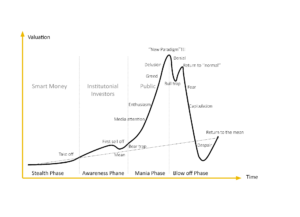
The market tends to assess a company based on how it looks right now, while an investor tries to evaluate the potential of that company.
The Problem With Anchoring
Investors might also anchor to past prices/valuations.
Just because a stock moves from ₹500 to ₹250 does not mean that ₹500 was a rightful price of this stock. Also, just because the same stock moves from ₹250 to ₹500 does not automatically mean that ₹500 is the rightful price of the stock.
The relevant question always is:
How much is this business worth given what it knows about itself and where it will go in the future?
Sometimes strong companies hit their ultimate bottom in bad news instead of good news. Expectations have to get reset, weak holders should get out, pessimism needs to be priced into the stock before the next chapter starts.
It is this which makes the early stage so tough.
You are not buying a stock when everybody agrees with you. You buy when you have enough evidence, but there is not enough information available.
That is what the Stealth Phase is all about.
The stock could remain range-bound. Investors’ interest in it might not be high. The story remains negative. No visible signs of success of your thesis emerge.
And that is the point when investors start doubting themselves.
Being Early vs Being in a Value Trap
Whereas the previous stock has been weak, another stock may start becoming stronger. The market seems to move on, and it starts coming to your mind whether there really was an opportunity.
In some cases, however, it is not because the analysis was incorrect.
It is because the investor believed that the market would realise the thesis faster.
This creates one of the most critical differentiations within the investing community, and that is being early and being stuck in a value trap.
Externally, the two may appear almost similar. They both involve unpopular stocks. Both can fall after purchase. And both can remain undervalued for an extended period of time.
The difference is what is taking place beneath the price.
In the case of a value trap, the investment thesis starts failing.
However, in the case of being early, the thesis may still be intact; only the realisation by the market takes longer than expected.
Thus, conviction does not involve holding onto the failing stock.
Conviction involves knowledge of the situation.
Should there be any changes in the business, the balance sheet, dynamics of the industry, or the initial thesis, it should become easier to change your mind.
However, if the underlying circumstances remain unchanged, price weakness alone should not be the basis for selling the stock.
Contrarians are not people who disagree with the market just for the sake of disagreeing.
The market can always be right.
What matters is finding the point where reality differs from the perception and knowing the business well enough to withstand the period before the discrepancy is solved.
Know What You Don’t Know
The stock market offers you thousands of companies in multiple industries. It seems that the ideal investor should understand everything about them.
The opposite is often the case.
You do not need to understand everything. You need to understand those things that you understand well and stick to those limits.
It is the concept of the circle of competence.
An unknown business will appear exciting simply because you do not know its drawbacks yet. An intriguing plot, a new technology, or an attractive sector will create the illusion of the opportunity without giving you enough understanding of the risks involved.
It means that “I do not understand this enough” is not a restriction. It is an investment strategy.
The aim of the game is not to purchase each good business that you come across. The aim is to find those businesses where your understanding gives you an advantage.
Nevertheless, after finding the business, you have problems with psychology again, with confirmation bias.
You will be tempted to look for only those pieces of information that support your thesis. True understanding requires the opposite action.
Ask:
“What could prove me wrong?”
Look for the weak points, not the confirmation that your position was right.
Good industry knowledge will help you separate a temporary uncertainty from the real problems. It will also make you less dependent on the opinions of others since you have your own criteria of what matters.
Your circle of competence will not tell you what you should buy.
It will tell you what you should avoid.
The Multibagger Test: Can You Actually Hold It?
Identifying a potential multibagger is just the start.
It’s not easy knowing whether you’ll have the fortitude to hold through the duration of time necessary to make the investment work.
Not all multibaggers require the same time horizon to unfold. Some might need two or three years, others five years, and some may even take a decade or more to materialize.
Your resources, ambitions, and patience should align with the opportunity’s time horizon.
The first year could prove to be quite challenging.
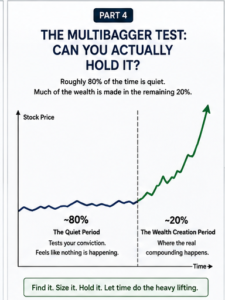
An opportunity to make a multibagger investment could find the stock in a tight range, while the company is slowly making progress on its path to growth. It may not excite, generate attention from the market, or display any indication that the idea is coming to fruition.
This is when most investors would like to exit.
There’s a key point to consider here: approximately 80% of the time, nothing will happen, while the rest of the 20% creates the wealth.
Position Sizing Matters
Just because a stock doubles 10 times or increases 25 times in price doesn’t mean your portfolio would have benefitted because initially you had just 1% or 2% exposure and never built it up.
The idea isn’t just about spotting the trade; it is about building an exposure to the investment thesis as it gets validated.
This is where “averaging up” comes into play.
An investor can start by buying a small portion of the stock, assuming that the stock is highly undervalued. As the business strengthens, its earnings increase, and the market starts validating the thesis, then the investor can buy more shares.
The size of the holding will increase not because the stock is getting cheap, but because the investment thesis is getting more validated.
Patience isn’t about sitting tight and doing nothing.
It is about giving enough time for the business to validate your thesis while being ready to change your mind when facts say differently.
The Mathematics of Losing Money
Of course, investors think much more about how much money they could earn than how much they could lose.
However, drawdown mathematics shows that things are different.
If ₹100 drops to ₹90, one needs to earn 11% to be at ₹100 again.
If ₹100 drops to ₹50, one should earn 100% in order to regain the initial position.
It illustrates why losses cannot be viewed as the reverse side of earnings. The bigger the drawdown, the more difficult it is to get back to the original position.
So, investment success does not depend on being right.
Position sizing can be more important than being correct.
Making mistakes is inevitable. One should try to minimize losses in case of mistakes and allocate the necessary amount of funds when one is right.
The approach is focused on those investments that have downside protection due to certain features, like deep value, a solid balance sheet, or a margin of safety.
Risk and Uncertainty
There is a distinction between risk and uncertainty. An enterprise may experience uncertainty regarding its recovery schedule while having no significant risks associated with permanent loss of capital. The same applies to a debt-free, cash-rich, market-leading firm, which was acquired at a meaningful discount.
While diversification may lower risk, it shouldn’t take the place of understanding. If you understand the underlying business well, selective concentration might prove more productive than diversification among a multitude of stocks.
The issue of liquidity also exists in micro- and nano-cap stocks, which could be easily acquired but hardly sold when market liquidity evaporates.
Before investing, try asking yourself: “Do I want to make money fast or build greater wealth?”
Discipline to Do Nothing
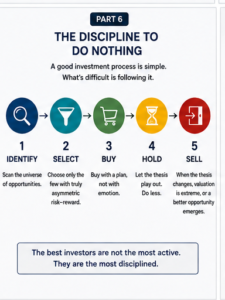
Buying, selling, and looking for opportunities is not what investing is about. Knowing when to buy and when to sit tight is the essence of successful investing.
The procedure could be summarized as:
- Identifying
- Selecting
- Buying
- Holding
- Selling
Not all opportunities deserve your capital. Your ability to say “No” to numerous opportunities leaves your money free for investments having a favorable risk/reward ratio.
Having selected the company for investment, try not to make any unnecessary moves. If the investment thesis holds up well, the changes in price and the opinions of other people shouldn’t trigger you to do anything.
Doing nothing might be the most disciplined and capital-allocative move to make.
When Should You Sell?

One shouldn’t sell because he or she feels uncomfortable regarding the price movement. Here are the reasons to sell:
- It became extremely overvalued.
- The investment thesis got broken.
- A far superior alternative emerged.
- You need liquidity.
The first one is disciplined, while the second one is an emotionally triggered reaction.
Large losses are bound to create an urge to recover fast, whereas large gains lead to overconfidence. One should try not to make emotional decisions after suffering losses or gaining profits.
The most successful investors aren’t those who make a lot of decisions, but those who understand what decisions to make.
The Investor You Become
As time passes, investing ceases to be about stocks. Rather, it becomes an exercise in how you deal with risk, expectation management, and capital allocation.
Ultimately, financial freedom and choice become more important than higher returns on investment. You don’t have to know anything about all companies and invest in everything. Just in those companies you understand, and your capital works effectively in them.
Wealth has to be considered not only in terms of your portfolio but through your spending habits, liabilities, savings, and investments.

A 50% or even a 100% return in one year might look impressive. However, long-term compounding plays a much more important role.
Investing is like a marathon, not a sprint.
Wealth, Frugality and Financial Freedom
It is impossible to avoid all expenses and be frugal. Being frugal means understanding that unnecessary expenditure is money you won’t be able to compound.
Creating real wealth means making wise decisions both in good and bad times for the market.
Ultimately, the goal is financial freedom, which means the state where you get enough choices because of your money.
The Final Lesson: Concentrate on Yourself
There will be another stock that performed better and another investor who earned more money.
Comparing yourself with others only brings unnecessary distractions.
Therefore, concentrate on allocating your capital, time, attention, and energy.
Investing teaches you how to allocate capital. Eventually, it will teach you how to allocate yourself.
Concentrate on yourself, and you will grow. Concentrate on distractions and distractions will grow.
If you need guidance on how to start your stock market journey, how much capital is enough to begin with, how to do smart investing, or how to take informed stock market decisions, you can join Strategic Alpha’s ‘The Conviction Club’. This is a membership program, especially curated to help investors become aware and knowledgeable about stock market trends, news, and technical aspects, so that they can become their own experts.
Our YouTube channel, weekly webinars, and digital resources available on the website can help you learn the basics of the stock market. For regular updates on trends, one-to-one sessions with experts, and detailed learning modules, you can join the Conviction Club, which is the online community of like-minded investors sharing knowledge and thoughts to grow together.
Subscribe to the Strategic Alpha Newsletter now to get the latest updates about weekly webinars.
Join Me On My Telegram Channel Where I Share Much More Value Adding Knowledge Of Investing/ Trading: Click Here
Also, Don’t Forget To Follow Us On Our Social Media Accounts:
Facebook: https://www.facebook.com/strategicalpha/
Instagram: https://www.instagram.com/strategicalpha/
Twitter: https://twitter.com/suyog_dhavan
YouTube: https://bit.ly/2IIqztO
Disclaimer: Strategic Alpha and Suyog Dhavan are not SEBI-registered investment advisor. The content provided is purely for educational purposes and should not be construed as financial or investment advice. Viewers are encouraged to conduct their own research or consult with a SEBI-registered professional before making any investment decisions.