
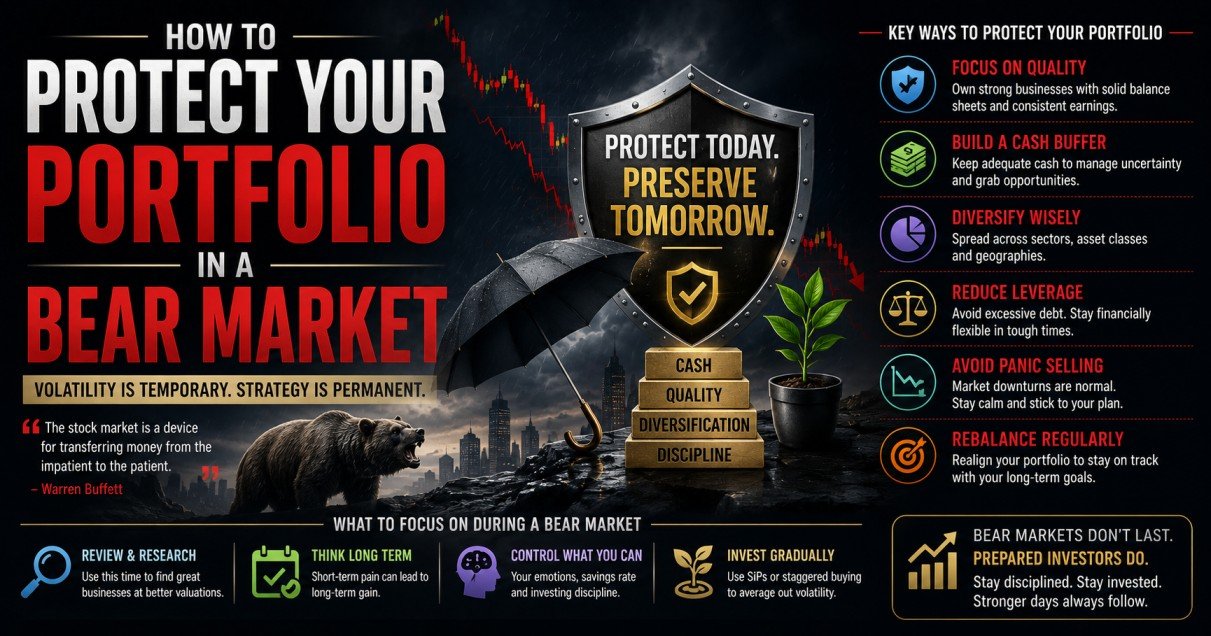
It’s common for investors to feel afraid when the market starts falling. And that often becomes the reason for emotional decisions made in a hurry. Headlines turn negative, and even long-term investors might feel uncertain. It’s true that stock markets are risky, but the risk can be minimized with the right strategies. Bear markets make investors feel uncertain, but it is important for investors to be prepared. In such situations, you need to make decisions strategically, not emotionally.
Thank you for reading this post, don't forget to subscribe!What Is a Bear Market?
The term “bear market” generally describes the situation in which the stock market has fallen dramatically from its previous levels and stays under pressure for an extended period. Unlike a market correction that typically occurs over a relatively short period, a bear market tends to be more prolonged and is often associated with larger economic issues such as inflation, higher interest rates, weaker growth, or geopolitical instability.
While a bear market may be unpleasant, investors need to understand that it is a normal part of stock market investing.
Things to keep in Mind:
Here are a few points that you need to remember during a bear market
1. Panic is Not the Answer
One of the most common mistakes that investors make while facing bear market conditions is panic selling. It makes sense to get out of the market when you see prices dropping daily. However, panic-selling often means that you make your temporary losses permanent.
Rather than reacting to each change in the market, it is advisable to be more patient. If you made your investments according to your long-term goals, there is no need to change anything when the market takes a downturn. If you are patient enough to wait, you will most likely receive the returns you aimed for.
2. Review Your Portfolio Thoroughly
Bear markets present an opportunity for re-evaluation of your portfolio. It is crucial to know where your funds are allocated and assess whether this distribution aligns with your investment objectives, risk tolerance, and time frame.
It is possible that when markets are performing well, your portfolio is heavily skewed toward stocks or risky assets. Bear markets can uncover such imbalances in your portfolio. Conducting an analysis will allow you to pinpoint areas in need of adjustment. You can shift your money toward less risky assets.
3. Prioritize Quality Over Hype
When markets are booming, investors are inclined towards high-growth or extremely speculative assets. However, a bear market scenario is characterized by the dominance of quality rather than hype.
Quality is the key focus during bear markets. Investments that have solid fundamentals like consistent income generation, low leverage levels, positive cash flows, and robust business models are likely to perform better than others during volatile conditions. While quality investments might not protect against losses entirely, they are usually better in terms of recovery.
4. Diversification Can Minimize the Damage
The best way to secure your investment portfolio is through diversification. When you put all your eggs into one basket, whether stocks, bonds, or real estate, your portfolio is highly impacted when the market turns against you.
Investing in different securities, such as stocks, bonds, cash reserves, and precious metals, will minimize the risks associated with investing. Diversification is not a surefire formula for earning profits, but it will definitely make your portfolio stable when the market gets tough.
5. Maintain Enough Liquidity
While liquidity may not seem important when things are going well, it becomes very significant in a bear market environment. The presence of sufficient liquid money or assets will allow you to avoid selling your holdings at inopportune moments.
If you have any near-term obligations, EMI payments, financial commitments for your family, or even an emergency fund plan in place, then maintaining adequate liquidity becomes very critical. A properly hedged portfolio is not only about generating superior returns, but also about managing risk.
6. Try a Defensive Approach
Under stressful market conditions, certain sectors and investment approaches prove to be more resilient compared to others. It is common for investors to focus on those asset classes that are considered more defensive and are less impacted by any slowdown in the economy.
This doesn’t mean abandoning growth completely, but it does mean being more thoughtful about where risk is being taken. In uncertain markets, protecting downside becomes just as important as chasing profits.
7. Do Not Try to Time the Market
It is tempting for many people to think that they will sell their assets when prices reach their peak and then buy back at their lowest point. However, it may not be so simple, and a few days of market recovery can make a huge difference in the overall results.
Rather than trying to guess where the market will go next, it is usually wiser to follow a disciplined strategy. Rebalancing your portfolio and investing gradually can often work better than making sudden all-or-nothing decisions.
8. Have a Plan and Stick to It
It’s impossible to foresee the exact timing of a bear market, but being able to plan for one’s needs, risks, and expectations makes it possible to cope with it successfully.
A bear market poses challenges, yet at the same time, it rewards those who are patient enough to think of the future. A well-constructed portfolio is often the key solution.
Bear Markets Can Create Opportunities Too
While bear markets are challenging, they can sometimes offer great opportunities for investors. Good-quality investments often become available at more reasonable valuations during downturns.
For long-term investors, this can be a chance to strengthen a portfolio rather than simply fear the decline. The goal should not be to blindly buy everything that falls, but to look for solid investments with patience and clarity.
Conclusion
Investment in stocks is never an easy process, especially when the stock markets are going through tough times. However, investors need not worry because, in such situations, all that is needed is making wise decisions, which will help to preserve one’s investment portfolio.
It may not be pleasant when the markets tumble, but it is critical not to panic since, in the investment world, survival usually paves the way for success. If you are a beginner and feeling overwhelmed with such situations, you can learn stock investing with Strategic Alpha. Join our weekly webinar or become a part of our ‘Conviction Club’ to receive the right mentorship.
FAQs
Q1. What is a bear market?
Ans. A bear market is a situation in which the stock market falls to a great extent over a long period.
Q2. How can I protect my portfolio during a market crash?
Ans. The best way to protect your portfolio during a market crash is:
- Be patient
- Diversify your portfolio across different asset classes
- Maintain liquidity
Q3. Should I sell all my stocks in a bear market?
Ans. No, it’s never a good idea to do panic selling and sell all your stocks in a bear market. If you have invested for the long-term, stay invested.
Q4. Which sectors perform well in a bear market?
Ans. Defensive sectors, such as consumer staples, utilities, and healthcare, usually perform well in a bear market.
Q5. Is it a good time to invest during a bear market?
Ans. Not always, but yes, bear markets offer great investment opportunities too. But make sure not to make any decision in a hurry. Talk to your mentors or thoroughly analyze the stock before investing in it.
If you need guidance on how to start your stock market journey, how much capital is enough to begin with, how to do smart investing, or how to take informed stock market decisions, you can join Strategic Alpha’s ‘The Conviction Club’. This is a membership program, especially curated to help investors become aware and knowledgeable about stock market trends, news, and technical aspects, so that they can become their own experts.
Our YouTube channel, weekly webinars, and digital resources available on the website can help you learn the basics of the stock market. For regular updates on trends, one-to-one sessions with experts, and detailed learning modules, you can join the Conviction Club, which is the online community of like-minded investors sharing knowledge and thoughts to grow together.
Subscribe to the Strategic Alpha Newsletter now to get the latest updates about weekly webinars.
Join Me On My Telegram Channel Where I Share Much More Value Adding Knowledge Of Investing/ Trading: Click Here
Also, Don’t Forget To Follow Us On Our Social Media Accounts:
Facebook: https://www.facebook.com/strategicalpha/
Instagram: https://www.instagram.com/strategicalpha/
Twitter: https://twitter.com/suyog_dhavan
YouTube: https://bit.ly/2IIqztO
Disclaimer: Strategic Alpha and Suyog Dhavan are not SEBI-registered investment advisor. The content provided is purely for educational purposes and should not be construed as financial or investment advice. Viewers are encouraged to conduct their own research or consult with a SEBI-registered professional before making any investment decisions.