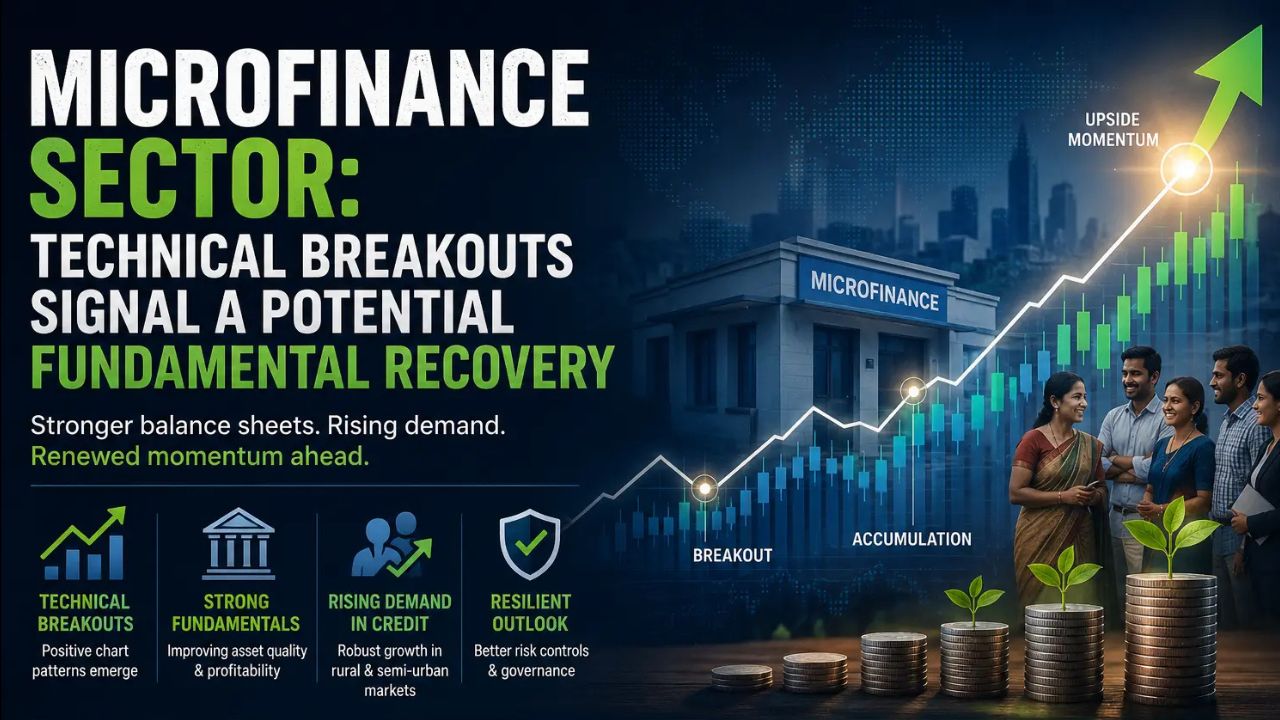
Over the past couple of years, the microfinance sector has been through one of its toughest periods characterized by high stress, poor collection rates, and issues relating to borrower leverage. Even so, industry views coming out from management, analysts, and investors have increasingly indicated that the sector may have seen the worst of the downturn. At one time for some period, however, the stock market had been reluctant, with the prices not reflecting the improved conditions in the sector.
Thank you for reading this post, don't forget to subscribe!This is now changing, and some of the listed pure-play MFIs have started recording technical breakouts, drawing the attention of investors and traders. While the above is welcome, an analysis of whether the positive moves in price are based on improved fundamentals would call for a deeper study into the operations of the microfinance industry and the sector cycles.
In this article, we look at how the microfinance industry operates, the evolution of the industry in India, the cycles of booms and busts characterizing the industry, and how the industry has performed in relation to its cycle.
The Evolution of the Microfinance Industry
The concept of microfinance has been developed to solve one basic problem in the financial system, i.e., the provision of loan services to poor households that have remained out of reach of traditional banks. Modern concepts related to microfinance became well-known in the second half of the twentieth century when small loans, without any form of collateral, began to be provided to generate income among economically weak groups.
Muhammad Yunus, who is the pioneer behind the concept of microfinance, has contributed immensely to the development of the microfinance industry through his initiatives at Grameen Bank of Bangladesh. Grameen Bank was successful in proving that providing loans to poor individuals without any form of collateral could be quite productive from the financial point of view. His idea revolved around the provision of small loans, especially to women, through peer group responsibility rather than through collateral. The success of the Grameen model encouraged governments and NGOs to replicate such a model all over the world

One of the nations that adopted this model quite early on is India. While there have been many other channels of informal borrowing that have been around for decades, it wasn’t until sometime between the 1970s and the 1990s that the structured microfinance system became apparent through NGO-led Self Help Groups programs, bank linkages, and dedicated microfinance institutions. There was a rapid expansion in these models during the 1990s and early 2000s, which increased their reach in rural and semi-urban areas.
A key turning point in the development of this industry came in the aftermath of the microfinance crisis in Andhra Pradesh in 2010. It led to regulatory intervention and exposed some serious flaws in the system related to their lending and collection systems. As a result, the RBI stepped in and put together some strict regulations for this sector.
Subsequent to the implementation of stringent RBI policies, there has been a phase of professionalization in the industry where there has been an improvement in the governance framework, betterment of underwriting processes, diversification of services provided beyond microloans to include small savings and insurance products, as well as the expansion into previously untapped regions. This has led to growth in terms of the number of borrowers and gross loans under the portfolio of the sector.
The current scenario in the microfinance market of India sees multiple players in the category. There are NBFC-MFIs which continue to provide microloans on an unsecured basis. Apart from that, there are the Small Finance Banks (SFBs), which have moved on from microfinance alone to cover a broad range of banking services but still remain exposed in the area. Apart from that, even large commercial banks are involved in this segment either by themselves in terms of their microfinance segment or in partnership with specialized MFIs.
In the last decade, the growth rate for the microfinance sector in India has been nothing short of astounding with a CAGR of around 25%, ever since 2012. However, while the growth rates have been tremendous, they have hardly ever been smooth. The industry has continually witnessed cyclical trends, whereby the period of credit growth has been followed by a phase of correction before another period of growth starts. This cyclical trend is one of the most notable features of the industry.
How Does the Microfinance Industry Function?
The microfinance industry functions with an obvious purpose that consists of the delivery of formalized financial services to those clients who are usually ignored by banks. They often have no means of securing a loan since they lack collateral, formalized income statements, or any credit history that could help them get a bank loan. Thus, MFIs target mostly poor people, self-employed persons, and micro-enterprises working in rural and semi-urban areas.
Their usual needs consist of borrowing money to be used in agricultural activities, livestock rearing, some business, or just for managing a temporary money shortage. Since collateral is not usually provided, it becomes necessary to use field assessments, involvement of the borrower, and repayment control methods instead of collateralized loans.
Origination Process for Loans
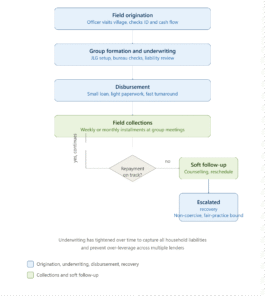
In contrast to retail banks where customers have to visit branch offices for applying for loans, loan origination in microfinance starts right from the ground level. Field officers visit the villages and poor urban areas to identify potential customers and to originate loans.
The first step would be to conduct basic due diligence. The identity and residential proof of the customer needs to be verified and household cash flows need to be assessed. The borrower’s indebtedness is determined through credit bureau reports. Borrowers are usually put into Joint Liability Groups (JLG) or other group formations which help in making timely repayments as the borrower knows that his fellow members will also monitor his repayments. Although the loans can be disbursed individually, the decision-making process continues to depend heavily on local market knowledge and household cash flow and bureau checks.
Speed is one of the main features of microfinance. The documentation requirements are less, loan amounts are relatively lower and approval time is faster.
However, faster processing does not equate to lenient underwriting. With time, the sector has developed and become quite conservative when underwriting credits. The institution evaluates the total debt position of the borrower, which includes debts from other MFIs, banks, and bullet loans, before considering any additional credits. This is done to curb the problem of multiple borrowings and excessive leverages that have continued to arise every now and then in the past.
Recovery and Collection Process
The repayment process for microfinance is different from conventional retail lending. In microfinance, the borrowers make repayments through smaller installments and not larger EMIs. The frequency of repayments could be weekly, fortnightly, or monthly depending on the product type and geographical location.
Field collection process remains the primary means of collections. Loan officers go round visiting borrower groups and individuals to make collections, monitor repayment behavior, pursue non-performing loans, and engage with the communities at all times. This way, success of the microfinance approach will depend not only on contractual agreements but on continued borrower engagement as well.
The very moment when borrowers begin to demonstrate weak repayment performance, creditors will always follow the staged approach. At first, creditors will try to establish contact with the borrowers by means of follow-up contacts, counseling, and if necessary, restructuring repayment schedule. The more vigorous activities to recover debt will be initiated in the event of continuous problems in repayment.
It should be noted that during the last years the industry has attached considerable importance to the issue of ethical debt collection. Regulatory rules and fair practices prevent creditors from using coercive recovery methods, which may negatively affect the relationship between creditors and customers, the reputation of the industry, and cause some political and social reaction.
Microfinance Industry – Cycles and Patterns
Just like other credit-based business activities, the microfinance industry goes through repetitive cycles of expansion and correction. Periods of fast expansion are often followed by stressful periods. Hence, microfinance is an industry that tends to be cyclical in nature. While every bust happens because of a particular factor, the factors leading to every bust tend to be the same. Fast credit growth, fierce competition, weakened underwriting standards and increased borrower leverage build the vulnerabilities of the system, which in turn, makes it sensitive to the slightest triggers.
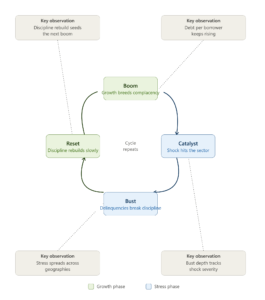
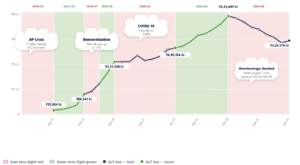
During the past fifteen years, there have been multiple booms and busts in India’s microfinance industry, each one being triggered by a certain factor.
The first major bust was associated with the Andhra Pradesh microfinance crisis back in 2010. Regulatory interventions and political resistance significantly hindered collections and lending activities in the biggest microfinance market in the country at that time. The bust has radically altered the course of development of the microfinance industry.
It took some time for the industry to recover after 2011 when RBI has created the NBFC-MFI regulation.
The next shock to the industry came in 2016, with the demonetisation policy disrupting the cash-driven borrower base, causing a significant collection performance decline. The sector then recovered with great momentum during the years 2018-2019, driven by improved asset quality as well as higher loan origination growth.
The current period of industry contraction began around 2020-2022 due to the disruptions brought about by the coronavirus pandemic affecting field activities, income levels of borrowers, as well as their repayment discipline.
The current economic cycle, beginning in 2024, is quite different from previous industry declines in the sense that it was not caused by one major external factor but rather by borrower over-leveraging, increasing delinquency rates, localized income challenges, and the unwinding of the previous years’ aggressive lending boom.
Common Features in Every Boom Phase
While each of the above-mentioned corrections may have been caused by different factors, some common features have been seen in each of the preceding booms:
- Periods of extended strong growth that gradually undermine underwriting discipline.
- Fierce competition between lenders to increase loan portfolios.
- Increasing number of borrowers borrowing from more than one lender at a time.
- An upward trend in outstanding debts of individual borrowers.
These factors collectively create an environment where the industry becomes increasingly vulnerable to external shocks or internal stress.
What Happens During a Downcycle?
Once there is a triggering event – be it regulatory intervention such as the Andhra Pradesh crisis, macroeconomic events such as demonetization and Covid-19, or industry correction through leverage – the effects are always predictable.
Default rates start going up as portfolio performance deteriorates and collection gets harder. Firms that grew the fastest during the expansion period will be the first to get affected by growing defaults and their subsequent effects on asset quality and collection.
The impacts will not be limited to only one player or geographical area. When a region starts to relax its repayment rules, neighboring players will view defaults as acceptable behavior, thus causing spillover that will make stresses more pronounced.
Lenders that adhered to prudent credit risk management during the expansion phase do not usually face such stresses during the contraction phase. Prudent credit risk management process makes it easier for them to preserve capital and maintain lender confidence when other institutions face difficulties.
Interestingly enough, however, the groundwork is usually laid for the next expansion even during the contraction stage. As stress levels rise throughout the industry, banks restrict new lending operations and concentrate more on their collections work, their portfolios, and risk management. The lending climate tightens up again but in a more healthy way.
Signs of Recovery Onset
With this reset process in place, there are certain operating indicators that usually improve ahead of an industry expansion cycle. Traditionally, the following points have been indicative of the recovery process underway:
- Collection processes improve and stabilise at a more advanced level.
- Industry-wide asset quality pressure decreases.
- Lending banks become less active in initiating new disbursements and prioritise efficient collections instead.
- Repayment discipline among borrowers improves countrywide as the risks associated with defaults become apparent.
Why are these points important to note? For one thing, such signs of improvement usually appear before the loan growth picks up. Knowing the historical path followed by the industry in its cyclic development, the next natural question would be whether the current environment has these tell-tale signs and what stage of development does the microfinance industry find itself now?
Where Does the Industry Stand in the Current Cycle?
The current microfinance downcycle was triggered in 2024 when lenders witnessed lower efficiencies in collection activities and a worsening in the quality of assets held by their institutions. This is unlike any other period of growth because the companies have focused less on growing their portfolios and more on building up their balance sheet, implementing strict underwriting criteria, and better collection performance.
This shift in the microfinance market has been witnessed in some of the key operational metrics. The Gross Loan Portfolio (GLP) has seen a considerable decrease since its peak levels; there have also been lower growth rates for borrowers, and lenders have spent a few quarters working on improving efficiencies in collections rather than disbursing funds to new borrowers.
The most significant development in the current downturn has been the implementation of more safeguards throughout the industry. Recognizing the problems that arose due to borrower over-leverage, safeguards were instituted that are geared towards ensuring discipline in the use of credit. These include borrower exposure limits, limitations on the number of lenders that can lend to any particular borrower, and more strict underwriting standards which mandate that institutions consider all liabilities before issuing new loans. Together, these safeguard are aimed at avoiding future problems from the buildup of over-leverage in the system.
These structural developments indicate that the industry will come out of the downturn with a much better operational framework than in the past. The industry has not just improved its operations based on the improvement in the economic environment but has taken advantage of the downturn to improve its risk management systems and lending discipline.
Operational signs are beginning to show this as well. For the first time in eight quarters of the downturn, the industry’s GLP has registered positive quarter-on-quarter growth. On the other hand, majority of the listed microfinance players have guided for a strong recovery in Assets Under Management (AUM) and an uptick in disbursements in the current financial year.
The guidance from the management of the pure-play microfinance companies, as well as those which are involved in microfinance business in a big way, further corroborate the aforementioned positive trend in the business. The managers are of the opinion that the stress in assets has already peaked and repayment behavior of many borrowers in different regions has started normalizing. With improvement in collection efficiency and better discipline among the borrowers, the industry seems to have moved past the stage of balance sheet cleanup and into the stage of recovery.
It is still premature to say that the cycle has turned; however, several aspects of the current situation remind us of the situation seen at the end of previous down cycles. It has been seen that the period of improving collection efficiency, stable asset quality and disciplined lending has formed the base for the next leg of growth.

The next stage, on the other hand, is to determine which entities can take advantage of this recovery. Although there are many financial firms that have stakes in microfinance operations, the extent of involvement differs widely and it becomes crucial to differentiate pure-play MFIs from other diversely involved players.

Positioning of Different Participants within the Microfinance Sector
As per MFIN, there are almost 200 microfinance participants present in the Indian microfinance sector. While many of them are small and unlisted, the listed universe has different institutions having varying exposure to the microfinance sector. The need for understanding such different segments is vital since all these players do not have an equal impact due to the credit cycle of the microfinance sector.
The first segment is that of pure play microfinance institutions where most of the Assets Under Management (AUM) come from unsecured group loans. Such companies include CreditAccess Grameen, Fusion Finance, and Satin Creditcare Network.
The second segment is that of Small Finance Banks (SFBs). These banks used to be microfinance institutions until they got their banking licences. While some level of exposure to microfinance remains, the nature of their operations has broadened and now involves different products like retail, MSME, housing, and other forms of loans. Therefore, such banks can be considered as partial players in the microfinance cycle.
The third category includes commercial banks and larger NBFCs which have some portion of their loans portfolio invested in the microfinance segment. Notable players in this space include RBL Bank, Kotak Bank (via its subsidiary), Manappuram Finance and IIFL Finance. Due to their diversified business model, the influence of microfinance cycles on the earnings is quite low.
Lastly, there are speciality finance companies like MAS Financial Services and Northern Arc Capital which follow the business model of lending to microfinance institutions. These firms help fill up the funding gap for the MFIs which might face challenges accessing traditional banking due to the higher risks associated with the business.
Though all of the above financial firms have an investment in the microfinance sector to some extent, pureplay MFIs provide the most authentic indicator of the microfinance cycle. Due to the significant percentage of their earnings from unsecured microfinance lending, the performance and valuation of the MFIs are highly correlated with the fundamentals of the industry than diversified financial firms.
Thus, for investors looking to track the revival of the microfinance sector, pureplay MFIs act as a better proxy. Based on this, a few listed firms have been shortlisted below.
Key Companies to Watch
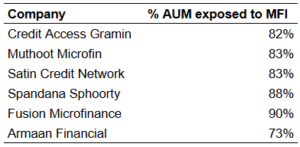
Credit Access Grameen
Credit Access Grameen is the largest publicly listed microfinance institution in India. It has proven to be an institution with discipline in its execution, through various business cycles. In difficult times, it has been able to manage its write-offs while in favorable situations, it has grown without letting down its standards of underwriting. Such consistent performance has helped the company gain a premium valuation, and it is currently valued at 3x P/B.
Muthoot Microfin
This company is promoted by Thomas Muthoot, who is the promoter of Muthoot Fincorp. This gives the company strong parentage and brand recognition among its borrowers. As the company has been recently listed, it does not have much of a public record spanning multiple industry cycles. However, its parentage gives additional security to the investors, especially when the industry is going through stressful times. Looking at the valuation of the company, it is currently trading at 1.4x P/B.
Satin Creditcare Network
Promoted by Dr. Harvinder Pal Singh & family, Satin Creditcare Network was incorporated in the 1990s. The company started its operations using its own internal resources and later raised capital from private equity firms starting in 2008. Unlike CreditAccess Grameen or Muthoot Microfin that have the support of institutions, Satin Creditcare Network has managed to sail through all major slumps in the industry in the past and has always come out of it in a better shape. At present, the stock trades at 1x P/B, making it one of the lowest valued stocks in the space.
Spandana Sphoorty
The private equity firm Kedaara Capital backs Spandana Sphoorty. However, from what we understand, the risk management capabilities of the company were not up to the mark during the last expansion cycle. Aggressive expansion plans in 2023–2024 made the portfolio highly vulnerable when the industry went through its current slump. This led to poor asset quality, resulting in erosion of a lot of shareholder equity. Nevertheless, the stock still trades at 1.2x Price-to-Book.
Fusion Finance
Similar to Spandana Sphoorty, Fusion Finance, which is backed by Warburg Pincus and managed by founder Mr. Devesh Sachdev, has had a journey that has been characterized by rapid expansion during the boom phase but later faced the effects of increased risks associated with its credit portfolio in the following phase. Despite the recent tough times, Fusion Finance remains valued at around 1.4x Price-to-Book, positioning it well relative to a few other competitors.
Arman Financial
Backed by the Patel family and headed by Mr. Jayendra Patel, Arman Financial has been able to keep consistent underwriting standards despite the boom or bust market environment. The company has had some of the best operating results within the industry in both phases, indicating how the company has been able to maintain proper standards. The company is currently valued at around 2.2x Price-to-Book, and from our research, the valuation is reasonable.
Conclusion
The microfinance industry in India has had a cyclic nature, where every growth phase has been characterized by a correction phase. Despite having different reasons for each correction phase including regulatory measures, macroeconomic shocks and borrower over leverage, the nature of the cycle has not changed. Every correction phase has been an opportunity for the industry players to come up with better underwriting practices, regulations and risk management practices that have made the sector resilient.
The current phase looks like it is following the same path. The increasing collections efficiency, stable asset quality, growing GLP quarterly, as well as management expectations of growing AUM and disbursements are some of the indications that the industry may be at the beginning of recovery stage. For investors, the only lesson to take home from such cycles is that institutions that have good underwriting practice are likely to prosper in correction cycles.
At Strategic Alpha, we understand the importance of analyzing industry cycle along with analyzing companies’ fundamentals in order to find good business opportunities for our investors.
If you need guidance on how to start your stock market journey, how much capital is enough to begin with, how to do smart investing, or how to take informed stock market decisions, you can join Strategic Alpha’s ‘The Conviction Club’. This is a membership program, especially curated to help investors become aware and knowledgeable about stock market trends, news, and technical aspects, so that they can become their own experts.
Our YouTube channel, weekly webinars, and digital resources available on the website can help you learn the basics of the stock market. For regular updates on trends, one-to-one sessions with experts, and detailed learning modules, you can join the Conviction Club, which is the online community of like-minded investors sharing knowledge and thoughts to grow together.
Subscribe to the Strategic Alpha Newsletter now to get the latest updates about weekly webinars.
Join Me On My Telegram Channel Where I Share Much More Value Adding Knowledge Of Investing/ Trading: Click Here
Also, Don’t Forget To Follow Us On Our Social Media Accounts:
Facebook: https://www.facebook.com/strategicalpha/
Instagram: https://www.instagram.com/strategicalpha/
Twitter: https://twitter.com/suyog_dhavan
YouTube: https://bit.ly/2IIqztO
Disclaimer: Strategic Alpha and Suyog Dhavan are not SEBI-registered investment advisor. The content provided is purely for educational purposes and should not be construed as financial or investment advice. Viewers are encouraged to conduct their own research or consult with a SEBI-registered professional before making any investment decisions.