
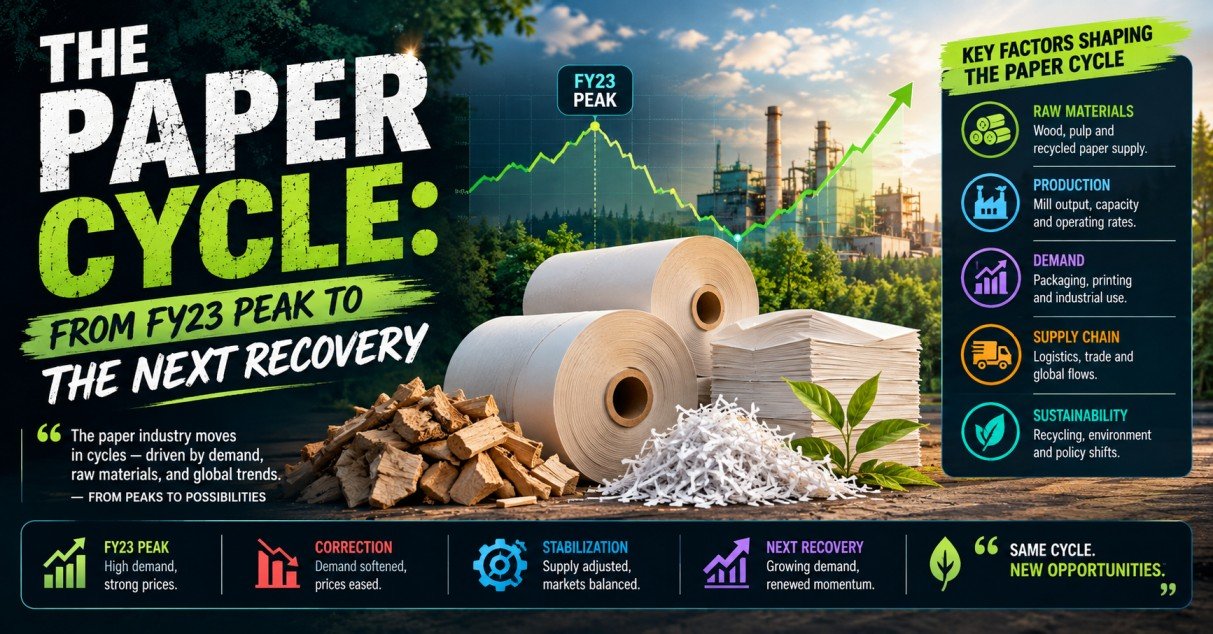
The paper industry is likely not the first industry that would come to mind when considering economic recovery or opportunities for investment. Yet, the paper industry in India saw some rather unique developments over the past few years.
Thank you for reading this post, don't forget to subscribe!The financial year of 2023 was extremely good for the paper companies. The demand has recovered quickly post-COVID, paper prices rose considerably, and paper companies have been able to sell their product at considerably higher prices and with better cost management.
This was close to the ideal condition for any cyclical industry.
However, what had risen sharply in FY23 came down just as sharply during FY24 and FY25. There were rising costs of raw materials, selling prices, and competition from imported paper. Now, as we enter FY26, there seem to be changes on the horizon. The key question here is no longer whether the industry has seen tough times. Clearly, it has.
Yet, the more interesting question is this:
Has the paper industry reached the bottom of its downcycle?
To answer that question, we will have to understand why FY23 was so successful.
When the Paper Industry Was at Its Peak
Demand recovery was the first key driver of the FY23 boom. During the pandemic, a large portion of the usual demand for Printing & Writing Paper evaporated instantly. Schools and colleges had been shut down. Work was being done from home. Commercial activity took a hit. The result was that the demand for conventional paper products took a hit. However, once economic activity got back to normal, a large portion of this demand came back into play. Schools and colleges got back to work. Offices got going. Business activities got back to normal. As a result, there was a surge in the demand for paper consumption.
The Printing & Writing segment, which had been struggling for several years, witnessed an increase in demand and much-improved pricing. Record sales were realized as the market reacted to post-pandemic demand. There was a second, larger growth driver on the horizon.
Packaging Became The Real Growth Story
Opening up the economy also meant that there was a rise in demand from FMCG, pharmaceuticals, consumer durables, and e-commerce. There were more goods being manufactured and sold, which led to an increase in the need for packaging. This increased the need for boxes, cartons, labels, and other paper-based packaging materials.
By FY23, packaging made up nearly 67% of India’s total paper demand.
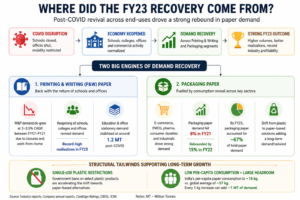
Therefore, the industry was witnessing the effects of two big factors simultaneously. Paper demand was going up, while the demand for packaging materials was rising rapidly. However, the high demand alone does not explain why profits were high.
Global Supply Problems Created a Perfect Environment
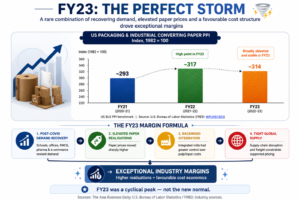
While demand was slowly improving, there were some other factors that were putting paper and pulp industries under stress. Freight rates were high. Supply chains were disrupted. Pulp was still tight. The Russia-Ukraine war put even more pressure on energy and commodities markets. As a result, paper and pulp prices in the world reached multi-year highs. And this was favorable for Indian paper producers since they could sell their goods at considerably higher prices.
This was especially true for integrated paper plants. An integrated paper plant has better control over its production chain. Rather than relying on external purchases of pulp, it produces a substantial portion of pulp itself. And this becomes quite important in case the price of pulp is rising drastically. In other words, it can take advantage of high selling prices while not having high costs of raw materials.
And the industry had a very favorable spread:
High selling prices + better control over the cost of inputs = higher margins.
The figures speak for themselves.
The paper-industry listed firm in question saw revenues of around ₹1,310 crore and ₹379 crore of EBITDA in FY23, putting its EBITDA margin at about 29%. In the listed paper industry as a whole, FY23 thus saw exceptional profitability and record performance. The other positive trend to note was the structural shift towards paper packaging. Constraints on the usage of some plastic materials made paper more attractive and gave a further boost to packaging demand.
So what made FY23 stand out?
It was not one particular reason alone.
Several positive developments took place at once:
- Demand picked up.
- There was a surge in packaging demand.
- Paper prices surged.
- Supply remained tight globally.
- Pulp prices were high.
- Integrated companies were able to manage their costs better.
Paper substitutes benefited from a structural boost owing to constraints on selected single-use plastics. From a cyclical industry’s perspective, it was almost an ideal combination. Unfortunately, there was a downside. FY23 could be considered the peak of the cycle rather than the new normal. And once the cycle turned, the same operating leverage that had helped companies during the good times started working against them.
When the Cycle Turned
This is because the good days never give you any indication of when they are about to end. Following FY23, the favourable conditions started disappearing slowly. The period of FY24 and FY25 was completely opposite to what the previous year witnessed. While input prices were increasing, the selling prices were falling. This marked the start of the decline. And one such major concern was the rise in the price of wood.
Wood Became Expensive
Wood is one of the key raw materials for paper production. However, in the financial years 2024 and 2025, the acquisition of wood proved to be difficult and expensive. It is not just the paper producers who compete for this raw material. Industries such as plywood, medium-density fiberboard, and others also competed for the same. Not only that, but there was a separate problem too. The planting cycle of plantation wood was affected by COVID. Thus, the availability of plantation wood was affected later on.
This led to a sharp rise in the domestic wood acquisition cost. Increases in prices have been reported to range between 34% and more than 80%. Thus, the price of wood was an issue. Companies in some cases had to source wood from a farther distance. The cost of transportation and freight thus also went up. Thus, the costs in the paper industry started increasing.
A manufacturer normally can increase its price in response to the increase in its cost of production. However, this is not easy in a competitive environment. This leads us to the second major problem.
Cheaper Imports Entered the Market
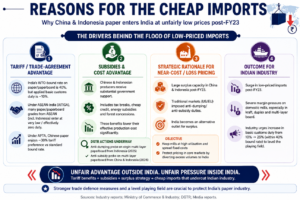
While Indian mills were grappling with rising costs of wood, trends in the international paper market were quite different. China and Indonesia had expanded their paper and paperboard capacity considerably during the preceding years. However, domestic demand in China did not pick up as anticipated.
In effect, this meant that some producers had excess capacity and production to sell outside their own country. Simultaneously, there were increased trade barriers for exporters in many developed countries. Thus India offered itself as a convenient market.
There was one additional attraction for some foreign producers: India’s trade regime and tariffs on imports enabled several grades of paper and paperboard to enter India at extremely low preferential duties. Through the ASEAN-India trade arrangement, for instance, several grades from ASEAN countries could enter India at extremely low or even at zero preferential duty.
Thus, for producers from countries like Indonesia, competing aggressively in India was relatively easy. And the timing was particularly bad for Indian paper manufacturers. Imports were increasing at exactly the time when domestic companies needed pricing power the most.
The Perfect Margin Squeeze
Consider the case of a paper maker in this scenario. The rising cost of paper making has occurred due to increased prices for wood, chemicals, energy, and other inputs. In usual cases, it would have raised its selling price. However, there is a catch here.
The buyer can always procure similar paper from a foreign supplier at a reduced price. Hence, the domestic producer cannot raise its prices in full. It needs to secure volumes and ensure that its huge plant capacities remain utilized. This is the worst-case scenario for any cyclical business:
Rising input costs + falling selling prices = falling margins.
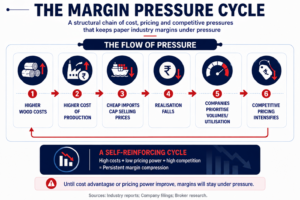
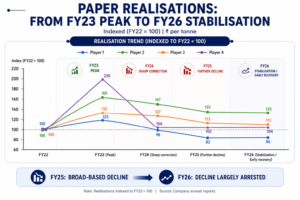
And that was precisely what happened. Realisations for Printing & Writing paper fell for two successive years. There were also significant reductions in prices for Packaging paper and board. For instance, one of the publicly listed entities recorded reductions in sales-realizations of approximately 17% in Writing & Printing Paper and 18% in Packaging Boards.
This is an important point.
The problem of the industry was not the failure of demand. The demand stayed relatively resilient in several end uses. The real problem was that companies could not turn their demand into profitable prices anymore. There was demand for paper. The problem was that the producers were not getting enough profit from each ton they sold.
The FY23 Advantage Also Disappeared
Another key factor occurred. Over FY23, integrated mills had benefited immensely from the very high levels of global pulp prices. Those companies which made their own pulp were insulated from having to purchase the expensive market pulp. However, as soon as global pulp prices started to fall, the benefit diminished. Imported pulp got cheaper. It helped narrow the cost disadvantage of non-integrated companies. Thus, the remarkable margin benefit of the integrated paper mills over FY23 started to normalize.
On the other hand, the high level of profitability witnessed during the past cycle had led to capacity additions, especially in packaging. With additional capacity coming up when the selling price was under pressure, the competition intensified. The competition intensified as companies fought for volume. This added further difficulty in passing on the higher costs to customers. The whole cycle had been reversed.
Is the Paper Cycle Finally Turning?
By FY25, the paper industry had travelled a significant distance away from the FY23 conditions. It had gone from being in a condition where the demand was robust, realisations were strong, supply was constrained globally, and the margins were favorable to one in which domestic fibre costs were high, imports were cheaper, realisations were down, and margins were under pressure.
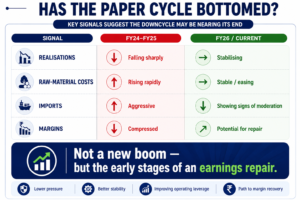
However, cycles don’t usually proceed linearly. With the onset of FY26, there are indications that the worst of the downcycle is behind us. What this does not mean is that the paper industry is about to turn around completely into conditions that were prevalent in FY23.
First Signal: Realisations Have Started Stabilising
The most immediate issue following FY23 was declining prices for pulp. There have been sharp declines in realizations in FY24 and FY25 as a result of competition from imports. However, FY26 may turn out differently.
Overall, realizations in the industry have stabilized, with a growth rate of about 2% to 4% in realizations. Compare this to the FY25 realizations, which had dropped about 10% to 16% in the industry. This is a significant development.
The industry narrative now is not:
“Prices are going down every year.”
Instead, it is slowly becoming:
“Prices have stopped going down.”
And in a cyclical industry, this can be the first indication of a bottom forming. The next question is what is happening to costs.
Second Signal: Cost Pressure Is Easing
Not only were there declines in paper prices in the FY24 and FY25 periods. The more significant issue was that costs were rising at the same time.
Wood was costly.
Pulp was costly.
Freight and other operating costs were high.
At present, it seems like the cost inflation trend is slowing down. It does not imply that all raw materials are now cheap. That is not what we are trying to say. The significance of this matter is that the severe cost inflation seems to have peaked.
CareEdge is confident that normalisation of hardwood pulp prices, along with stable wastepaper and bagasse prices, will lead to margin improvement of around 200 basis points in FY26. In addition, there are signs of wood prices becoming stable and a reduction in prices of about 5% to 6%. It may not seem like too much to say. But look at what took place before. At a time when wood prices increased by 30%, 50%, or even more, every increment reduced margins. When wood prices cease increasing, the math of the business is affected.
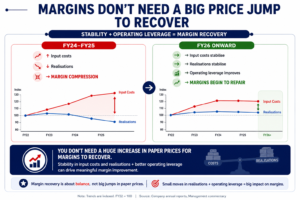
Take, for example, the case of a manufacturer who sells paper at ₹70,000 per tonne.
If costs continue increasing, margins continue to decrease. But if the ₹70,000 per tonne continues to be the same and costs are no longer increasing, margins will begin increasing without a significant increase in selling prices. This explains the importance of the spread. The sector does not need a huge increase in paper prices. The sector needs the spread between the selling price and cost of production to be stabilized.
Third Signal: Imports May Be Losing Some of Their Impact
Imports were one of the major concerns during the economic downturn. In other words, even if local cost pressures are stabilising, one issue is still relevant:
Can paper producers in India manage to restore pricing power?
Some preliminary indications suggest that the answer may be positive. Recent industry publications indicate that imports are becoming less aggressive. Certain problems related to transportation, lack of shipping containers, and logistics issues in some cases make imports less attractive. Furthermore, import prices of paper are currently stable as opposed to falling.
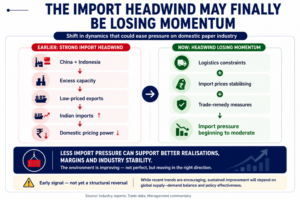
This is significant because during the past two years domestic producers had to face:
High local cost pressures + low prices of imported paper.
If import prices stop falling and imports become less active, domestic producers may get additional pricing flexibility. Moreover, anti-dumping and anti-subsidy initiatives are being considered. This does not mean that imports will end. India is still one of the key markets for foreign producers of paper, and imports will affect domestic prices. However, there is a considerable difference between aggressive imports and manageable imports.
What About Paper Prices From Here?
Current paper realisations stand at ₹68,000-₹69,000 per tonne, while the company management expects them to hit ₹72,000-₹75,000 over the next 4-6 months.
The crucial thing here is not the target itself but the shift in direction. With two consecutive years of price declines, there will now be talks about prices going up. This, combined with stable costs, can bring substantial improvements in margins.
Is Another FY23 Coming?
In FY23, we’ve seen an unusual scenario where a combination of high post-pandemic demand, cost pressures and strong realisations worked together.
Now, however, everything is changing. The cost environment has become stable, the floor for realisations has been found, and imports have stopped being aggressive.
Does it mean another FY23 is on its way? No, it means that the margin pressure is getting relieved and there is a chance for earnings recovery.
What Investors Should Watch
Investors should be primarily focused on the following factors:
Paper realizations: Are prices stabilizing or increasing?
Wood prices: Are raw material prices decreasing or stabilizing?
Importation: Is cheaper imported paper being less aggressive?
Profitability: Are companies benefiting from improved realizations and stable prices through greater profitability?
Along with these four, investors should assess each individual firm’s balance sheet, capacity, and execution. A recovering industry does not necessarily mean all firms will perform well.
Final Thoughts
The paper industry was going through an exceptional FY23 year but has now entered a tough FY24-FY25 down-cycle. Currently, the first signs of recovery are emerging for FY26. Realizations have stabilized, cost pressures have subsided, and imports are less aggressive.
The industry doesn’t require an exceptional FY23 year to achieve greater profits. The industry requires only the stabilization of costs, improved realizations, and less aggressive imports.
With such developments in the industry, its cycle can be entering the next phase and that is why the industry deserves attention again.
If you need guidance on how to start your stock market journey, how much capital is enough to begin with, how to do smart investing, or how to take informed stock market decisions, you can join Strategic Alpha’s ‘The Conviction Club’. This is a membership program, especially curated to help investors become aware and knowledgeable about stock market trends, news, and technical aspects, so that they can become their own experts.
Our YouTube channel, weekly webinars, and digital resources available on the website can help you learn the basics of the stock market. For regular updates on trends, one-to-one sessions with experts, and detailed learning modules, you can join the Conviction Club, which is the online community of like-minded investors sharing knowledge and thoughts to grow together.
Subscribe to the Strategic Alpha Newsletter now to get the latest updates about weekly webinars.
Join Me On My Telegram Channel Where I Share Much More Value Adding Knowledge Of Investing/ Trading: Click Here
Also, Don’t Forget To Follow Us On Our Social Media Accounts:
Facebook: https://www.facebook.com/strategicalpha/
Instagram: https://www.instagram.com/strategicalpha/
Twitter: https://twitter.com/suyog_dhavan
YouTube: https://bit.ly/2IIqztO
Disclaimer: Strategic Alpha and Suyog Dhavan are not SEBI-registered investment advisor. The content provided is purely for educational purposes and should not be construed as financial or investment advice. Viewers are encouraged to conduct their own research or consult with a SEBI-registered professional before making any investment decisions.