
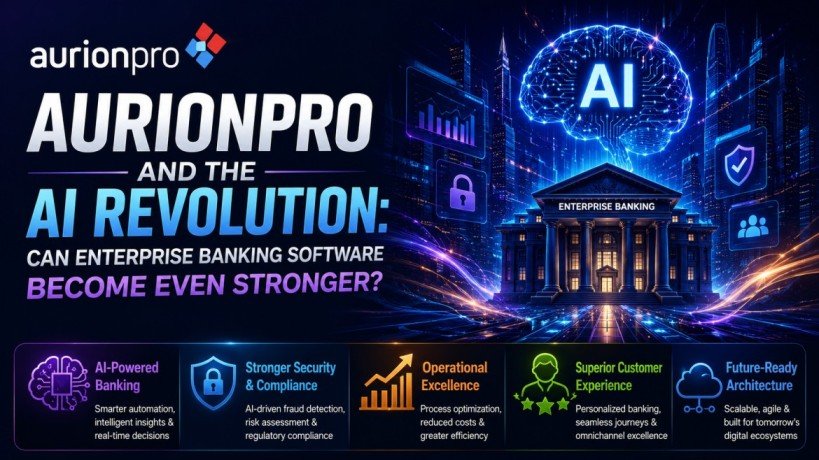
Artificial intelligence technologies have triggered an intense debate in the software industry. In line with the increasing efficiency of code writing through the use of AI technologies, there arises the question of whether the competitiveness of software companies will decrease in the long term because they could start to lose their competitive advantages as software could be created in weeks rather than months.
Thank you for reading this post, don't forget to subscribe!For most software companies, such fears are justified. The emergence of AI-based programming helpers and development technologies decreases barriers in the process of creating applications. Features developed for years can now be created much quicker.
Still, enterprise banking software is quite a unique thing.
The real value of banking platforms is not the code itself. It is based on years of experience in the domain, knowledge about regulations, integrations, frameworks, risk assessment, etc. This is something which AI systems will hardly ever be able to replace.
This principle lies at the heart of Aurionpro’s long-term AI strategy. Instead of seeing AI as a challenge, the company believes that it can improve its competitive advantage by making its banking platforms smart without compromising decades of institutional knowledge.
In this article, we discuss why Aurionpro sees AI as changing – not dismantling – the competitive moat of enterprise banking software.
AI Is Redefining Enterprise Software
Artificial intelligence is not just one more wave of technological innovations. This technology is revolutionizing the way companies build software and run their operations.
As opposed to previous technological waves which have digitized manual operations, artificial intelligence allows performing many of those tasks on its own. From analyzing documents and executing transactions to making recommendations and orchestrating business workflows, AI is slowly transforming from a support tool to an actor within enterprises.
This is why companies are making substantial investments in this technology.
Global expenditures on banking technology are projected to rise from around $115 billion today to close to $460 billion by 2030, powered by digital transformation, legacy system modernization, and greater AI adoption. Meanwhile, the investments in cloud, AI-powered data centers, and intelligent enterprise systems only keep getting larger as companies get ready for their AI-native future.
Similar developments can be seen in the world of transportation. Cities around the globe are implementing systems that move away from account-based ticketing and open-loop payments infrastructure to allow software systems to take over from custom-made hardware and generate recurring digital revenue.
All of these indicate that we are in the midst of a structural change, not just a technological cycle.
The key question that investors have to ask themselves at this point is not whether AI will revolutionize enterprise software but which companies will be able to benefit from this revolution.
Why Bank Software is Unique
A large number of horizontal software companies compete against each other by providing productivity software that does a lot of similar tasks in different sectors. CRM systems, document management solutions, HR software, sales automation platforms use standard workflows which become increasingly easy to automate via AI.
Banking software is inherently unique.
Financial institutions function in one of the most regulated sectors in the world. Each lending process, payment procedure, treasury management, trade finance process must follow the guidelines and be highly transparent, auditable, and reliable.
Creating software in such environment goes well beyond programming.
Banking enterprise software needs to take into account regulations changes, interface with old core banking systems, handle approvals processes, monitor operational risks, and work flawlessly all the time.
Such capabilities have been achieved over many years of deployments for customers and iterations on the product line, not through AI-generated code.
This is exactly what Aurionpro has been thinking.
The moat of Aurionpro was never about the code
The evolution of Aurionpro from an IT services company into an IP-oriented company producing enterprise products has resulted in its banking products being based on specific financial flows instead of software functionality.
The product line of the company speaks for itself:
- iCashPro+ enables transaction banking, liquidity and cash management, supply chain financing and corporate treasuries, with millions of transactions per hour processing capability.
- SmartLender digitalizes the entire lifecycle of lending, including credit evaluation, collateral management, approval hierarchy, early warning systems and recovery processes.
- Fintra transforms the trade finance area through automation of documentary credits, guarantees and cross-border trades.
- AuroPay and Interact DX enable payment orchestration and compliant customer communication.
These products do not only automate banking operations but embody the very nature of how banks operate.
Building an application for loan origination is not a hard problem anymore, as there are a lot of modern tools to generate most of the software functionality. The hard thing is building a system which would incorporate the bank’s credit policies, comply with all the regulations, keep audit trails, integrate with core banking and evolve along the way.
This knowledge is not added after the development of the software product. In case of enterprise banking, it is integrated in the software itself.
Institutional knowledge is the competitive advantage of Aurionpro. This company accumulated decades worth of implementation experience for its customers and other kinds of knowledge like regulations knowledge, workflow orchestration knowledge and product features improvements.
Why switching cost stay exceptionally high
Enterprise banking software has another layer of protection – exceptionally high switching costs.
Swapping a solution like SmartLender or iCashPro+ cannot be compared to swapping a generic business software tool. Banks have to migrate historic data, integrate the new critical systems, comply with regulations, train their employees and keep business running during migration process.
The risk involved with all that is usually higher than the benefit of replacing incumbent solution.
This is how Aurionpro explains why AI doesn’t undermine its moat. When software is competing just by writing code, then yes, AI will help competitors replicate it. But banking software competes with something else – domain expertise, regulations knowledge, workflow orchestration and customer trust.
According to the company, the use of AI technologies in these platforms makes them faster, smarter, and more efficient. What these platforms cannot do without is the wealth of experience in banking that has been built into them.
This is the key to Aurionpro’s AI policy. The company expects that the next generation of banking enterprise software will be characterized by AI and deep institutional experience.
From Software 1.0 to AI-Native Banking: Long-Term Vision of Aurionpro
Artificial Intelligence (AI) not only transforms software engineering; it transforms the function of software within an enterprise.
Historically, enterprise applications were the system of record. Users entered data, analyzed information, went through pre-defined workflows, and moved the task from one stage to another manually. The system was efficient at storing data, but people took care of decision-making and workflow execution.
According to Aurionpro, this concept changes rapidly.
Not just support employees in workflow execution, enterprise applications start doing parts of the workflow on their own. AI can analyze financial statements, validate customers’ documents, synthesize information, pull data from multiple systems, detect exceptions, and make suggestions before bankers intervene. People become less and less involved in execution of processes and more and more responsible for overseeing AI’s decisions.
This evolution is described by management as shifting from Software 1.0 to Software 2.0.
While regular updates can be completed by incorporating a chatbot or an AI assistant within an existing application, AI needs to be built into the application architecture and allow intelligent agents to work with the enterprise systems, execute processes, learn from previous decisions, and justify every single recommendation.
This change in architecture helps to understand one of the key strategies that Aurionpro has used.
Instead of waiting for the disruptive moment to start modifying products, the company decided to redesign several of its core banking solutions at a time when they were already successful on the market.
In the short term, the strategy looks very costly as it requires huge R&D investments and affects margins. Nevertheless, from the point of view of management, rebuilding products is much safer than modernizing them once they have become old and customers start to ask for AI-based ones.
This shows one of the core principles of the capital allocation policy that was used in the company consistently.
Integration of AI goes far beyond the customer products
The AI vision at Aurionpro extends way beyond the banking solution for the customers.
Managements have stressed that being an AI-native software company is not just about leveraging tools such as GitHub Copilot or Cursor, which can help with the efficiency of the developer. They are working towards transforming the whole software development life cycle from the planning of the product to the coding, testing, deploying, maintaining, and customer support.
Internal projects are already bearing some fruit. In the FY26, the company achieved almost 7% improvement in the manpower productivity despite increasing hiring to meet growth objectives going forward.
It is an important point.
Unlike cutting the engineering bandwidth, with the help of AI, engineers will get less involved in the repetitive coding and maintaining jobs while spending their time on product innovations. In the longer run, this will enable Aurionpro to generate the revenue without increasing its engineering band significantly.
Arya.ai Creates an Initial Edge for Aurionpro
The strategy of Aurionpro with respect to artificial intelligence (AI) does not start with the current trend of generative AI.
The acquisition of Arya.ai helps the company have an enterprise-level AI platform that has more than 100 customers in place, creating an edge for the company with an installed base through which the company can commercialize its banking solution enabled with AI rather than developing one from the scratch.
It greatly reduces the risk involved with the execution of AI.
Instead of selling the new products to completely new customers, the company can introduce enhancements enabled with AI among its existing customer base through the process that the management calls brownfield deployments. Existing banking customers will be able to use the AI-enabled enhancements while keeping their trusted platforms intact.
An early case-in-point of this strategy is seen in the Fintra platform of the company.
Built specifically for modern trade finance, Fintra has been designed around AI-enabled workflows instead of traditional rule-based automation. Rather than simply digitizing documents, the platform aims to orchestrate complex trade finance processes using intelligent agents capable of coordinating multiple systems and business rules.
Management has also outlined similar modernization plans across transaction banking, lending, payments, and other core banking products, indicating that AI-native architecture will eventually become the standard across its product portfolio.
Creating AI that Banks can Use
The biggest misconception around AI adoption is the belief that creating powerful models gives companies competitive advantages.
According to Aurionpro, the true challenge starts once the model is created.
AI systems that banks deploy should not be considered black boxes as each recommendation for lending, payment, regulatory compliance, or treasury operations should be clear, explainable, and auditable.
For these reasons, the company started developing an ecosystem of technologies that goes well beyond generative AI.
After the acquisition of Arya.ai, Aurionpro added expertise in explainable AI, governance, and model monitoring enabling banks to monitor the AI-driven decision-making process rather than relying on the results of models.
Via Lexi Labs, the company developed Orion MSP, a foundation model tailored specially for structured enterprise data – the kind of data that drives all the decision-making processes in the bank. Supporting these tools are such technologies as TabTune, enabling fine-tuning of enterprise models, DL Backtrace, offering regulator-grade explainability, and Weave, an orchestration layer that facilitates working of multiple AI agents, enterprise applications, and business rules.
Considered separately, these products might be seen as distinct innovations.
However, when taken as a whole, they point to a larger strategy.
This company is not aiming to be just another player in the world of AI models.
Instead, it is creating the necessary infrastructure that will allow AI to operate in the highly regulated industry.
That difference will probably turn out to be far more important going forward.
How Banking Might Be the Exception to the AI Disruption Narrative
The increased worry about the AI-driven disruption of software companies is mostly because of the changes taking place in horizontal SaaS. Customer Relationship Management (CRM), Sales Automation, Document Management, Productivity apps, and more share similar purposes in almost any business regardless of the industry. With the cost and effort required for software development dropping thanks to generative AI, it becomes increasingly difficult to justify the competitive advantage of these platforms.
The situation with banking software is very different.
As opposed to enterprise-grade apps, the banking platforms exist right in the heart of the regulated financial institution. All payments, lending operations, treasury activities, and even trade finance require meeting certain regulatory requirements while keeping auditors, compliance officers, internal risks department, and customers happy. Just being intelligent will never be sufficient; all actions need to be clear, explainable, and traceable.
And here comes the difference between consumer AI and enterprise AI.
Let’s consider loan underwriting. The artificial intelligence algorithm might determine that the loan applicant is eligible for receiving credit by analyzing thousands of factors. Nevertheless, a bank cannot issue the loan just because it receives a valid prediction from the algorithm; it should be able to comprehend how it was produced, how well it aligns with internal lending practices, whether bias has been sufficiently mitigated, and keep all the documentation that will be subject to audit many years later.
This problem arises in transaction banking and trade finance. All payment orders, liquidity transfers, documentary credits, and guarantees have to blend into the existing infrastructure of banks smoothly.
Understanding these problems, Aurionpro decided to invest in making artificial intelligence applicable in the regulated environment of finance.
The acquisition of Arya.ai improved the firm’s abilities in explainable AI, model governance, and continuous monitoring. Using Lexsi Labs, the firm developed Orion MSP, a tabular foundation model tailored to structured enterprise data that is used to make the vast majority of banking decisions. Supporting this model is TabTune, which facilitates effective fine-tuning of enterprise AI models, DL Backtrace for explainability at the regulator’s standards, and Weave as an orchestration platform for linking AI agents with enterprise systems and business logic in a controlled manner.
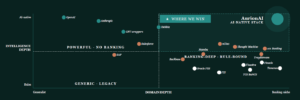
While all of these solutions seem independent, they share the same goal of helping banks embrace AI without sacrificing governance, compliance, or dependability.
That is likely also the reason behind the belief by Aurionpro about the advantage of the existing banking software vendors when it comes to the adoption of AI. Generative AI may help significantly lower the cost of writing software, but it can hardly recreate decades of deployment experience and customer confidence.
Ultimately, in banking, trust may become a stronger moat than AI itself.
Capitalizing on the Next Phase of Growth
The financials of Aurionpro provide interesting insights into how management is planning to make this shift.
This is best illustrated by the steady rise in the value of intangible assets and intangibles under development.
Contrary to the perception of aggressive accounting, these investments actually form part of management’s plan to convert their cash flows into intangible assets.
This has been the very essence of management’s transformation journey for several years now.
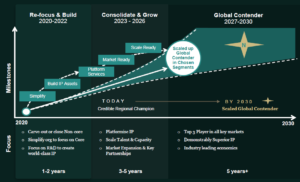
Under the ‘Aurionpro 2.0‘ business model, management has been shifting away from the pure-play IT services provider towards a product company focused on building enterprises around IP.
Businesses that did not fit in the model were exited or de-emphasized. This enabled management to focus their efforts on building banking software, enterprise AI, payments, transit solutions, and digital infrastructure businesses.
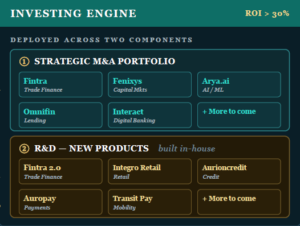
Over the last two years, Aurionpro has invested over ₹1,000 crore into its product offerings. Management has spent around ₹470 crore on internal R&D, while the rest has been spent through acquisitions.
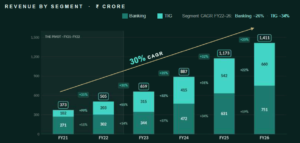
Interestingly, these acquisitions were not motivated by the need for size alone.
Each acquisition adds specific functionality to the overall banking value chain. While Arya.ai helps accelerate the firm’s enterprise AI offerings, Fintra has helped it increase its footprint in trade finance. Rather than standalone functionalities, all of these solutions work well together and increase the value add of the existing platform solutions offered by Aurionpro.
 The firm’s leadership refers to this approach as an “investing engine,” whereby the cash flows generated by existing operations keep getting recycled back into investments in technology development and acquisitions in order to build intellectual property that can be leveraged multiple times over different customers, verticals, and geographies. This is quite different from services revenue streams, which are typically non-repeatable.
This investing engine has entered yet another stage.
The firm’s management team is guiding an additional investment of ₹150-200 crores in the coming quarters as the development of AI native banking platforms gathers momentum. The firm sees that the time for such an investment is ripe since the enterprise software industry is entering a brief window during which next-generation architecture is getting built.
More spending on product development would increase the capitalized software base and weigh down margins and return ratios such as ROE and ROCE as against traditional IT services firms. Yet management feels that such comparisons ignore the basic difference between services and product firms.
Services firms grow through hiring more employees, resulting in cost increases as well as revenues increasing at the same time. Product firms follow another business model where they incur considerable costs in developing software that will earn them revenue streams over years to come, but with minimal additional investments.
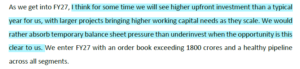
This is also the reason why Aurionpro spends about 7-10% of its revenue on R&D each year – much more than what an IT services firm should be spending according to the usual expectations.
Success for management is not judged by quarterly profits alone but by the quality of software assets being developed for the future decade.
Real Prize: Shifting Beyond IT Budgets
According to Aurionpro, AI is not just a technological improvement; it has the capacity to transform the very purpose of enterprise software for banks.
Enterprise software has traditionally been a system of records. It has kept records of data and transactions and helped in completing business processes. Although such a system has increased efficiencies, the process of analyzing information, decision-making, and workflow management has primarily remained the responsibility of individuals.
AI creates a whole new model of operation.
With intelligent systems being able to analyze financial statements, validate documentation, ensure compliance, retrieve information from disparate systems, make recommendations and even take certain actions, the software itself transforms into a system of action. It starts executing business processes, not just capturing them.
Aurionpro sees this transformation impacting banking across various fields.
For instance, in case of loans, an AI-based workflow may automatically collect data about customers, analyze their finances, validate documentation, check for policies, make credit recommendations, and route the application through a set hierarchy of approvals before it gets reviewed by the relationship manager.
Likewise, transaction banking can be enhanced through smart payment processing, liquidity management, sanctions screening, and exception handling, and trade finance can automate document validation, compliance checks, and cross-border transaction processing without significant manual effort.
This transition has consequences which go far beyond product features.
According to management, banks spend roughly US$350–400 billion per year on technologies, however, overall operating costs for banks are nearly ten times higher – in the range of US$3.5 trillion to US$4 trillion per annum.
In the past, enterprise software companies used to compete mainly for technology spending.
For Aurionpro, AI provides an opportunity to tap into a much bigger stream of operating expenditures.
Once the software starts to do work instead of just supporting it, technology vendors can become part of the operational process execution rather than providers of IT infrastructure to banks. Income models will slowly transform from license fees to subscription, usage based models and potentially outcomes-based commercial engagements.
It is believed that the introduction of agentic AI would cut the cost of certain banking operations by 50-70% due to the intelligent automation of repetitive and rules-based processes. Sharing these efficiency benefits between banks and technology companies can substantially grow the size of the addressable market for enterprise banking software.
This is the reason why Aurionpro keeps on aggressively developing AI-native solutions. Not only does the company try to develop better software; it prepares itself for the time when software would be integrated into the core operations of financial organizations.
Should this take place, Aurionpro will have opportunities beyond selling its banking solutions to customers. It will be able to contribute to how the banking organizations originate loans, perform payments, trade finance, comply with regulations, and execute various workflows.
Does AI Eliminate the Moat or Rebuilds it?
The whole discussion about artificial intelligence revolves around one question: Does AI make enterprise software more substitutable, or does it add value to those businesses which have deep industry expertise?
A lot of the market narrative has centered on this first possibility.
Generative AI has enabled the lowering of barriers to entry in software development, increased the pace of coding, and made software development easier than it has ever been. Of course, investors have been concerned about the potential reduction in the competitive advantage held by the incumbent software providers.
This is where the Aurionpro management team takes a different stance.
Aurionpro believes that code itself has never been a barrier to entry into enterprise banking. The real barrier is the understanding of how financial firms work, from dealing with regulatory changes to integration with the legacy systems to orchestration of workflows to establishing the necessary trust for mission-critical banking systems.
AI may speed up software development but cannot instantaneously reproduce years of experience and know-how accumulated in banking over decades.
It is this very belief which makes Aurionpro continue making huge investments in research, product development, and AI-native architecture despite the impact on the current profitability. The management of the company believes that the future generation of enterprise banking platforms will be provided by the players able to combine AI with deep domain experience.
On the other hand, it is still an execution play.
The banks take any change in technology quite seriously, especially if it affects their operations regarding lending, payment transactions, and core financial infrastructure. To succeed in commercializing AI-based banking platform, the company needs not only technological innovation but also good execution and adoption from clients, as well as migration of current clients to new-generation products.
In terms of investors, there would be more important metrics than just quarterly revenues. The growth in product subscription, implementation of AI-driven platforms, growth in the areas of lending, payment, trade financing, transaction banking and operating leverage through productivity increase from artificial intelligence will show that the business model works.
Artificial intelligence is changing enterprise software business for sure. What way it will affect competitive advantages will depend on the company’s reaction to the situation.
Aurionpro seems to understand that AI is not something additional for their products. This is an opportunity to rethink banking software in terms of intelligent, automation-driven and explainable workflow.
But if management pulls it off, then AI shouldn’t hurt Aurionpro’s competitive advantage; it should actually redefine it.
Investors will want to ignore the technology angle here and consider whether Aurionpro’s capital allocation, product development, and execution remain supportive of that vision.
At Strategic Alpha, we think some of the best investing ideas are those that occur when the market’s obsessed with short-term disruption and underestimates the durability of the competitive advantage. And that’s one of the themes at play with Aurionpro’s AI approach – not that the outcome is assured, but that execution will redefine what’s possible in enterprise banking software.
If you need guidance on how to start your stock market journey, how much capital is enough to begin with, how to do smart investing, or how to take informed stock market decisions, you can join Strategic Alpha’s ‘The Conviction Club’. This is a membership program, especially curated to help investors become aware and knowledgeable about stock market trends, news, and technical aspects, so that they can become their own experts.
Our YouTube channel, weekly webinars, and digital resources available on the website can help you learn the basics of the stock market. For regular updates on trends, one-to-one sessions with experts, and detailed learning modules, you can join the Conviction Club, which is the online community of like-minded investors sharing knowledge and thoughts to grow together.
Subscribe to the Strategic Alpha Newsletter now to get the latest updates about weekly webinars.
Join Me On My Telegram Channel Where I Share Much More Value Adding Knowledge Of Investing/ Trading: Click Here
Also, Don’t Forget To Follow Us On Our Social Media Accounts:
Facebook: https://www.facebook.com/strategicalpha/
Instagram: https://www.instagram.com/strategicalpha/
Twitter: https://twitter.com/suyog_dhavan
YouTube: https://bit.ly/2IIqztO
Disclaimer: Strategic Alpha and Suyog Dhavan are not SEBI-registered investment advisor. The content provided is purely for educational purposes and should not be construed as financial or investment advice. Viewers are encouraged to conduct their own research or consult with a SEBI-registered professional before making any investment decisions.