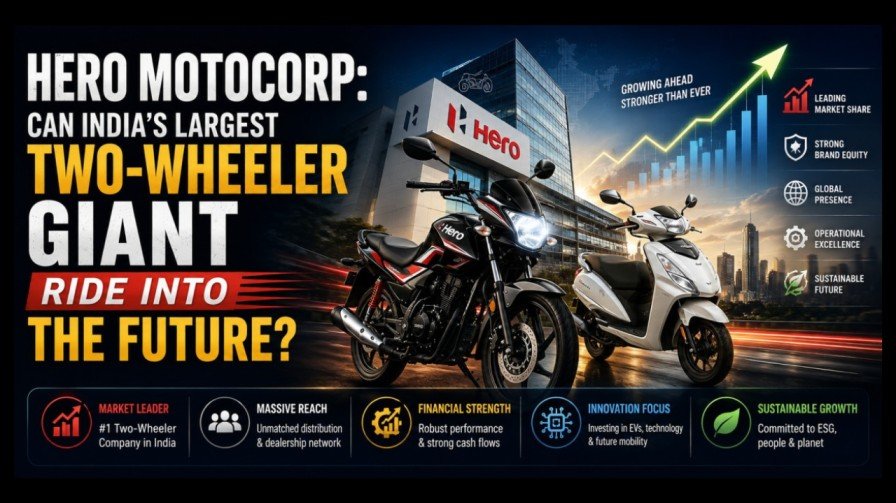
Part 1: The Making of a Legend: How Hero MotoCorp Conquered India’s Roads
There was a time when owning a motorcycle in India wasn’t about style, speed or technology. It was about one simple question:
Thank you for reading this post, don't forget to subscribe!“Kitna deti hai?”
For millions of Indian families, a motorcycle wasn’t a luxury, it was the family’s most valuable asset after their home. It took the breadwinner to work every morning, carried children to school, transported sacks of groceries and sometimes even served as a small business on two wheels.
Fuel efficiency wasn’t just a feature. It determined a family’s monthly budget.
And no company understood this better than Hero.
The story began in 1984 when the Hero Group partnered with Honda Motor Co. of Japan to form Hero Honda. It was a partnership that combined two very different strengths. Honda brought world class engineering and reliable four stroke engine technology, while Hero understood Indian consumers better than anyone else.
The timing couldn’t have been better.
India’s two-wheeler market was just beginning to expand, incomes were rising and customers were looking for motorcycles that were dependable, affordable and above all, fuel efficient. Hero Honda’s motorcycles checked every box.
Products like the CD100, Splendor and Passion quickly became household names. They weren’t flashy machines built for enthusiasts; they were built for everyday India. Mechanics could repair them easily; spare parts were available almost everywhere and owners trusted them to keep running year after year with minimal maintenance.
That trust became Hero’s biggest competitive advantage.
Over the next two decades, Hero Honda steadily expanded its dealer network into towns and villages where many competitors had little or no presence. While others fought aggressively in metropolitan cities, Hero quietly built relationships in rural India, where motorcycles were often a necessity rather than a lifestyle purchase.
By the late 2000s, the company had become the undisputed leader of India’s motorcycle market.
Then came a turning point.
In 2010, Hero and Honda decided to end their joint venture. Many industry observers believed Hero’s best days were behind it. The biggest concern was straightforward: without Honda’s technology, could Hero continue to compete against global manufacturers?
It was one of the biggest questions the Indian automobile industry had seen.
Hero had spent nearly three decades building its business around Honda’s engineering expertise. Now it had to stand on its own.
The company responded by reinventing itself.
The business was renamed Hero MotoCorp, invested heavily in research and development, established engineering centres in India and overseas, hired global talent and began developing motorcycles independently. It also expanded partnerships with international technology companies while strengthening its own product development capabilities.
The transition wasn’t immediate, and it wasn’t without challenges. Product innovation slowed for a few years, competition intensified and newer segments such as premium motorcycles and scooters became increasingly competitive.
Yet Hero never lost sight of its biggest strength; its core commuter business.
Even today, the Splendor remains one of the highest selling motorcycles in the world, a remarkable achievement for a product that has served generations of Indian consumers. Few consumer products in India have managed to build this kind of longevity and trust.
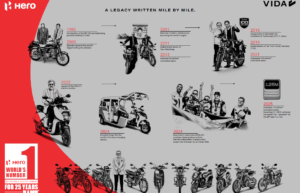
Over four decades, Hero MotoCorp has sold well over 120 million two-wheelers across India and international markets. Its distribution network now spans thousands of dealerships and service touchpoints, making it one of the most extensive automotive networks globally.
But the Hero MotoCorp of today is very different from the Hero Honda that dominated India’s roads twenty years ago.
The company is no longer just defending its leadership in motorcycles. It is investing in electric mobility through VIDA, building strategic stakes in companies like Ather Energy and Euler Motors, expanding its financial services ecosystem through Hero FinCorp and preparing for a future where mobility may look very different from the one that made it successful.
The question for investors is no longer whether Hero MotoCorp built a great business.
It undoubtedly did.
The real question is whether the company can reinvent itself once again and create the next chapter of growth in a rapidly changing automobile industry.
To answer that, we first need to understand how Hero MotoCorp actually makes money, where its profits come from and why its business model has remained so resilient for decades.
Part 2: Understanding Hero MotoCorp’s Business; More Than Just Selling Motorcycles
On the surface, it seems like Hero MotoCorp is a simple company.
They manufacture motorcycles and scooters; dealers distribute them; customers drive them; and money is made.
However, the truth about its business is far from being simple.
Every motorcycle that leaves a Hero showroom was created due to the development of a business ecosystem over 40 years that goes far beyond the manufacture and sale of vehicles.
Let’s start with the obvious.
Hero Motocorp manufactures about 5-6 million two-wheelers per annum and is considered among the topmost manufacturers of two-wheelers in the world. Although it has ventured into scooters and electric mobility, two-wheelers continue to form the mainstay of its operations in terms of volumes. Over 72% of its sales are from two-wheelers.
And its product portfolio is consciously diverse.
Splendor has always been the pillar of Hero Motocorp. Though it may not be the most powerful motorcycle in the market or the most technologically advanced one, its combination of cost, fuel-efficiency, reliability and low maintenance has made it among the top-selling motorcycles in the world.
Besides Splendor, some of its other products include HF Deluxe, Passion, Glamour and Xtreme.
First-time users in a small town, commuters in a big city, and delivery boys who drive hundreds of kilometres a week may have different needs. The strategy of Hero Motocorp has been to ensure that there is a suitable product for all of them in its portfolio.
But the motorcycle sale is only the beginning.
The Real Value Begins After the Sale
An owner earns money from his two-wheeler at all stages of its use.
Every motorcycle needs regular servicing, replacement parts, engine oil, tires, batteries, and add-ons. Although a buyer buys his motorcycle once every few years, he comes into contact with the Hero ecosystem multiple times during that period.
Thus, there is a very important recurring revenue generation avenue for both Hero and its dealerships.
So, in this case, the business does not stop when the buyer walks out of the shop. In many ways, that is where it really starts.
Now, let us talk about financing.
A major part of all two-wheeler sales in India is made through financing and not cash purchase. The Hero ecosystem enhances this through its subsidiary Hero FinCor, which finances vehicle purchases and other loans.
Accessibility to financing can directly affect the affordability of the motorcycle for a prospective buyer. In this way, financing not only enables sales but also widens the target customer base itself.
Distribution: Hero’s Hidden Moat
One of the key competitive strengths of Hero is its distribution and service network.
Hero boasts one of the largest networks within the industry, covering over 6,000 customer contact points in India. The network covers everything from big cities to small towns and even rural areas, providing Hero with an impressive geographic coverage.
That’s important since the buyer of a two-wheeler does not only consider the cost of buying a motorcycle.
Buyers consider many aspects that go beyond the price tag.
Is it easy to get spare parts? Is there a service station nearby? Can the local mechanic cope with such a motorcycle? How convenient will it be for maintenance? And finally, how easily will the vehicle be sold many years later?
The service network helps to deal with all these issues and lowers the risks associated with buying Hero’s products, adding value to the resale price of Hero motorcycles.
India Is the Core, But the Opportunity Is Wider
India continues to be the core of Hero MotoCorp’s business operations, but the company has also carved out its international footprint.
The company exports to over 40 countries, which include nations in Asia, Africa, and Latin America. Although the international markets are still a small part of the company’s business, they have provided another avenue of growth to the company while slowly decreasing Hero’s dependency on the Indian market.
For a company that is already huge in terms of domestic operations, international expansion may turn out to be an important source of incremental growth.
However, the real problem facing the company is right at home.
The EV Question
Hero MotoCorp spent many years creating a leadership role based on internal combustion engine motorcycles.
The coming decade could be very different.
The introduction of VIDA, Hero’s electric mobility brand, signifies the efforts by Hero to become a player in this ever-changing electric two-wheelers space.
However, the world of EVs is far different from internal combustion engine motorcycles.
Expertise in batteries, software, electronics, connectivity, charging solutions, and digital experiences are just some examples of what Hero would need to succeed in this business.
Hero would therefore be entering the space of EVs on a massive scale but not in a dominant position.
This is an important differentiation.
Hero would need to safeguard the franchise that created success for the company while at the same time building capabilities that could make the difference in the coming era of mobility.
What Makes Hero Difficult to Beat?
And now we have come to the crucial point.
Why is it so hard to compete with Hero?
It’s not just because they make good bikes.
Their competitive advantage is the blend of their brand reputation, economies of scale, massive distribution network, financial arrangements, installed customer base, and after-sales support.
All these advantages feed off each other.
The bigger your customer base, the better the support for dealers. The bigger your dealer network, the better accessibility you have. The better your accessibility, the stronger your brand. The better your brand, the higher the resale value and loyalty of your customers. Financial arrangements make it easier to purchase the bikes. And having a huge installed base makes after-sales more profitable.
That’s what makes the business system hard to replicate for a new company right away.
This may be the most crucial part of Hero MotoCorp’s success story.
Not only is the company manufacturing millions of bikes every year. For over four decades, it has been developing an ecosystem based on these bikes.
And now the company’s main task is to move this ecosystem into the new era of mobility.
How successful the company will be in doing so while not undermining its key strength. The bike business will define how much of the company’s competitive moat will be left standing in the next decade.
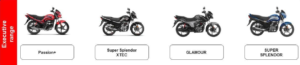
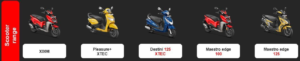
Part 3: The Hero Formula: Why Millions Still Choose Hero MotoCorp
Once every decade, a new challenger comes to the Indian two-wheeler market with a vision to transform the market.
Yamaha brought performance. Bajaj reinvented itself by building sportier motorcycles. Honda built its brand on its own. TVS gained momentum gradually. Recent challenges from Ola Electric and Ather have come from the perspective of electric mobility.
However, through all these years, there was only one name that kept winning: Hero MotoCorp.
What did Hero do differently?
The immediate answer would be fuel efficiency. The true advantage lies in its understanding of the Indian commuter.
For a first-time buyer in a Tier-3 city, a school teacher driving 40 kilometres daily, or a delivery executive earning through his motorcycle, what matters is simple:
How much fuel does it consume? How much servicing would it require? Are its spare parts readily available? Is it quick to repair? And how much resale value does it hold?
For such customers, a motorcycle is not only a means of transport. It is an earning tool.
This is how Hero structured its business around reality. The fact that Hero emphasized commuter motorcycles, low cost of ownership, easy availability of parts, and a servicing network allowed it to create not only market share, but trust.
And trust is hard to copy.
Trust comes from years of working with Indian roads, customers, suppliers, dealers, and mechanics. Competitors can develop a good motorcycle, but getting millions of people to rely on it daily will be a far greater task.
Furthermore, Hero’s strategy proved to be very disciplined. When competitors tried out different models such as luxury motorcycles, scooters, and even other markets, Hero stuck to commuter motorcycles that it knew well. In doing so, it probably missed some markets, but protected itself from overexpansion of its core franchise.
However, what has given Hero an advantage in the petrol age does not necessarily imply the same success in the electric age.
Many factors differentiate EVs from petrol motorcycles. Batteries, software, connectivity, charging, and digitization are becoming increasingly important.
For the first time in decades, Hero is not only competing in a market that it understands perfectly.
This is learning a new language.
And the most important question facing the company then becomes: Is it possible for Hero to leverage the trust and scalability gained during the days of petrol to gain an edge with electric vehicles?
This might well become the future of Hero MotoCorp.
Part 4: The Electric Question: Can Hero MotoCorp Reinvent Itself Again?
Whereas Hero MotoCorp’s first four decades revolved around the petrol engine, the next four might be dictated by the battery.
That’s why this EV adventure is so significant for Hero MotoCorp.
Hero MotoCorp used to be among the industry leaders in the two-wheeler business in India for many years. However, things have drastically changed due to electric mobility. While startups like Ola Electric and Ather made big leaps, existing brands, including TVS and Bajaj, started their own EV projects.
Eventually, Hero joined this race, launching its electric mobility brand, VIDA.
However, electric vehicles differ from traditional bikes in more ways than just energy source. Whereas a petrol vehicle is essentially a mechanical engineering product, an electric vehicle is increasingly becoming a combination of various technologies and capabilities ranging from the battery and software to connectivity and digital services.
In other words, Hero MotoCorp is not creating another kind of scooter. It is entering a tech ecosystem.
Moreover, Hero MotoCorp seems to be aware that it doesn’t have to develop all these technologies in-house.
Hero is an investor in Ather Energy and owns a strategic stake in Euler Motors, having thus entered into the EV ecosystem. This is critical for Hero because of the need to engage in the broader ecosystem of electric mobility beyond just VIDA.
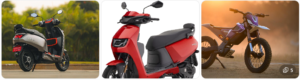
However, there are some obstacles.
VIDA functions in a highly competitive environment where innovation, price, range, software, and customer experience never stand still. Meanwhile, the electric two-wheelers have not yet reached the level of profitability of Hero’s traditional internal-combustion motorcycle business.
Thus, there is a tough balance to be struck.
Hero needs to keep up with the profitable cash flows generated by its core motorcycle business while spending enough money on the development of its EV segment. Inaction would be tantamount to giving up the coming generation of clients, while too much of the latter could be a challenge to profitability.
From what we can see so far, Hero has adopted the prudent approach to EV transition, building up the VIDA product line, developing technologies, increasing the size of the ecosystem and using the muscle of its traditional business to do that.
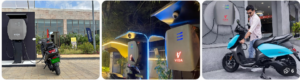
It is quite typical for Hero.
But the more important issue is not whether India will move towards electric mobility. It’s already happening.
What’s important now is whether Hero can build the same trust in the era of electric vehicles as it did in the era of petrol vehicles.
While this is yet to be seen, Hero has another value generator that most people overlook: its investments.
Part 5: The Hidden Value Most People Miss
Hero MotoCorp has been making investments in areas that will help the company gain exposure in finance, electric mobility, and commercial electric vehicles. All these individual investments are substantial in their own right. Together, they create yet another dimension of value which may be overlooked by the investors if they focus on motorcycles and profit margins only.
The largest one first.
Hero FinCorp: The Financial Backbone
“Can I Afford the EMI?”
That’s where Hero FinCorp plays its part.
What began as a financing wing of Hero soon grew into a diversified NBFC that provides vehicle loans, MSME loans, personal loans, and secured lending.
The stake of Hero MotoCorp in Hero FinCorp is 41.15%. Going by the latest IPO valuation of Hero FinCorp, which is roughly estimated at ₹15,000 crore, the valuation of Hero’s equity in Hero FinCorp works out to ₹6,200 crore.
However, the strategic value lies far beyond the valuation.
Financing makes motorcycles more affordable to the customer and thereby links the financing business of Hero to its core two-wheeler business.
Ather Energy: A Bet That Paid Off
One of the most intriguing actions by Hero wasn’t entering into the electric scooter business.
Hero invested in Ather Energy way back in 2016 when electric mobility had not yet emerged as a significant market. Today, Hero holds a roughly 29.2% stake in Ather Energy, making it the leading investor in the company.
Based on Ather Energy’s market capitalization of roughly ₹58,000 crores, Hero’s shareholdings have a total valuation of nearly ₹17,000 crores.
However, that’s not all the investment brings to the table.
Not only does Ather Energy have expertise in batteries, software, connected systems and electric mobility, but Hero, through the investment, is also able to gain experience in building India’s electric vehicle ecosystem as it forges ahead with its VIDA electric mobility offering.
Sometimes, the true value of an investment lies in something other than just the financials.
Euler Motors: Looking Beyond Two-Wheelers
The ambition of Hero towards mobility through electricity goes beyond motorcycles and scooters.
In 2025, Hero had invested ₹510 crore in Euler Motors, which builds electric commercial vehicles. Subsequently, the total investment amount was increased to ₹785 crore, resulting in a shareholding of 36.67% from the company’s side.
The investment made by the company would be worth approximately ₹730 crore at a valuation of ₹2,000 crore.
From the perspective of size, the investment would be modest in comparison with other ventures, such as that in Ather and Hero FinCorp. However, strategically speaking, this venture would provide Hero access to a different but growing market segment, i.e., electric commercial vehicles.
More Than a Motorcycle Company
Add up the three strategic investments and the situation becomes much more intriguing:
- Ather Energy: about ₹17,000 crore
- Hero FinCorp: about ₹6,200 crore
- Euler Motors: about ₹730 crore
Thus, we see that Hero MotoCorp has invested almost ₹24,000 crore strategically in addition to its own business using the valuations provided above.
These figures may vary depending on the market situation and not all investments can be equally profitable.
Nevertheless, there is one point to be noted regarding the story of Hero:
The company does not put all the cards into one deck.
Hero has a dominating position in the classical Indian motorcycle market, financial services via Hero FinCorp, and increasing involvement in several fields of the electric mobility industry via Ather and Euler Motors.
Thus, for investors, Hero MotoCorp offers a more diverse business than just its sales of motorcycles.
However, strategic investments are one thing but the profitability of the main business is another one.
So let us have a look at the figures.
Part 6: The Numbers Behind Hero’s Success
As a saying goes, a good story gets investment; but good numbers make investors stick around.
In the case of Hero MotoCorp, this has proved true.
Despite being part of a very competitive commuter market segment, Hero continues to report EBITDA margins of 14-15% compared to 12-13% of its competitor TVS Motor Company. Bajaj is ahead in terms of profitability with its margins of 19-20%, whereas Eicher Motors too reports better margins as a result of the premium brand Royal Enfield.
Even in terms of capital efficiency, Hero performs extremely well. It has a ROCE of around 35%, which is in line with Eicher Motors and ahead of TVS Motor Company and Bajaj Auto. The returns are achieved in spite of Hero being in the commuter segment and hence, the company shows its operational efficiency.
Another area where the balance sheet proves to be a strength is that Hero is still a net-cash company, which enables it to invest in Ather Energy, Hero FinCorp and Euler Motors and simultaneously pay dividends and undertake buybacks for its shareholders.
Then why does Hero not have the highest valuation among the peers?
And the answer to that is growth.
That makes Hero less of a turnaround story and more of a high-quality business searching for its next growth engine.
Part 7: The Road Ahead: Where Does Hero MotoCorp Go From Here?
It’s not Hero’s profitability or its balance sheet that’s Hero’s main concern. It’s finding the next growth driver.
Hero has multiple areas of focus rather than one big opportunity.
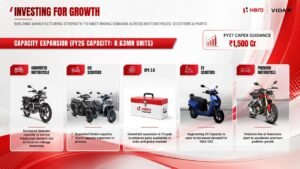
Hero has several new product lines, including commuter motorcycles, premium motorcycles, scooters, and electric vehicles. Hero is focusing particularly on scooters, with the Destini production capacity doubled and the Xoom production capacity planned to be doubled.
For electric vehicles, Hero is working on lowering the cost of ownership. Hero’s VIDA Battery-as-a-Service solution reduces the upfront cost of purchasing electric scooters, whereas expanding production capacity positions the company for the future.
Another area of growth for Hero is exports. Hero has expanded into Europe, Latin America, and Africa, targeting international markets as a key source of growth.
Moreover, Hero is planning capex in excess of ₹1,500 crore in FY27 to increase production, to scale EVs, and to establish an international components facility in Andhra Pradesh. Importantly, Hero is expecting to sustain its 14-16% EBITDA margins despite the investments.
The strategy is obvious: Hero does not aim for an instant make-over; it is creating its next phase of products, markets, and investments one-by-one.
By 2030, the success story of Hero MotoCorp could be about much more than just the Splendor. The true litmus test would be if the current investments turn into future growth engines.
Part 8: The Final Takeaway
Hero MotoCorp’s story isn’t just about building India’s largest two-wheeler company.
It’s about staying relevant in an industry that refuses to stand still.
For over four decades, Hero perfected the commuter motorcycle business. The next decade, however, won’t be won by protecting that legacy, it will be won by creating the next one.
That’s why Hero’s future isn’t tied to one product or one technology. It’s tied to execution, how well the company scales its premium portfolio, strengthens its EV business, expands globally and continues allocating capital wisely.
For people, that’s the real investment thesis.
Hero isn’t trying to fix a broken business. It’s trying to grow an already strong one.
And that’s an important difference.
The market already knows what Hero has built.
The real question is whether it can build the next chapter with the same discipline that built the first.
If history is any guide, that’s a question worth watching closely.