Occasionally, there comes a situation where a company is offered an opportunity which may be quite obvious to spot, but the market’s perception of the opportunity may be flawed.
Thank you for reading this post, don't forget to subscribe!Kernex Microsystems (India) Ltd. was one such example.
The firm is engaged in the railway safety systems market of India, especially in Kavach, India’s homegrown Automatic Train Protection (ATP) system. The firm enjoyed the potential of being involved in a lucrative opportunity, but the investors had a reason to stay sceptical because the firm failed to deliver on a large Kavach order it had received previously, thus getting the order canceled. Our investment call here was not about the company enjoying a large opportunity but much deeper. Was it finally executed?
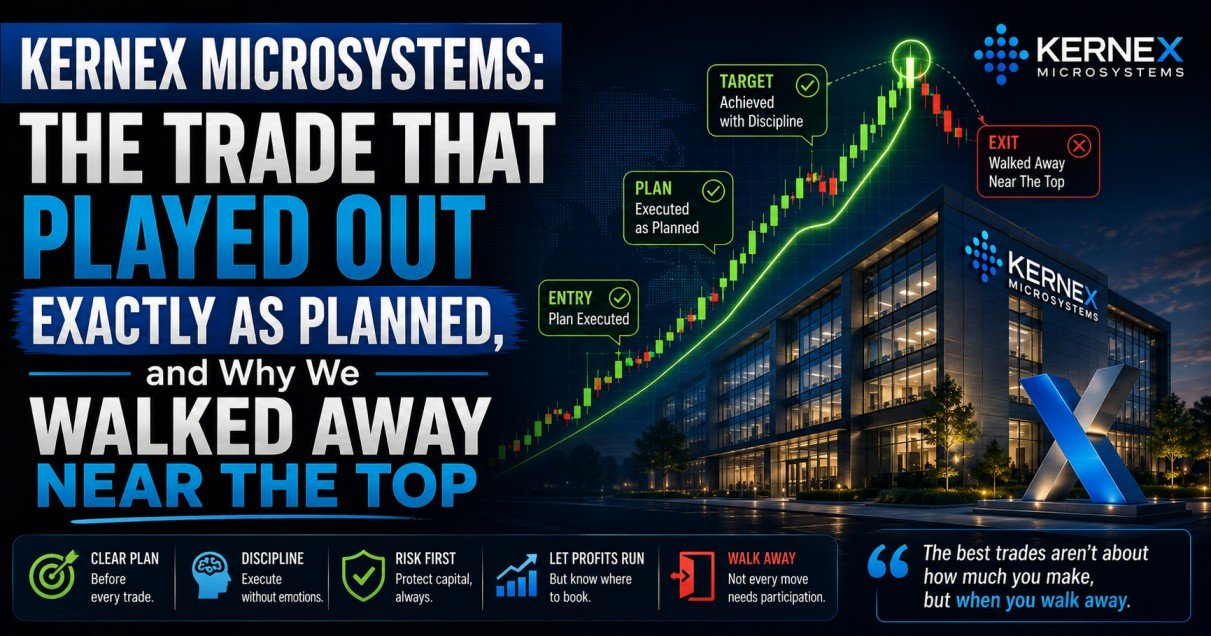
We had purchased the stock following the Q4FY26 results, where we found early signs of better execution, and by Q1FY27, our thesis was proved right. However, we also exited at that very point. The reason is simple: we had bought the stock on the back of a re-rating due to execution improvement, and the re-rating process was over.
What Is Kavach?
Kavach is an indigenous ATP which is designed by the Research Designs & Standards Organisation (RDSO). The purpose of the system is the prevention of train collisions with an automatic application of brakes in case of the loco pilot’s failure to respond properly to the signals.
There are three main components in the system:
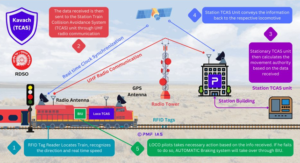
Onboard locomotive equipment – It consists of a Vital Computer, RFID reader, and Brake Interface Unit (BIU). The system monitors the train and provides the possibility of automatic application of brakes in case it is needed.
Trackside equipment – RFID tags installed on railway sleepers which help to define the train position, speed, and its direction.
Stationary station equipment – It includes a master computer at the railway station which communicates with the interlocking and signaling system and provides movement authority to the approaching locomotive.
It means that the train determines its location and speed by means of RFID. This information is delivered by UHF radio from the train to the station system, which calculates the movement authority of the train and sends it to the locomotive. In case the loco pilot doesn’t respond to certain situations, the braking system works automatically.
The investment case becomes interesting since Kavach is a highly regulated market.
Only three OEMs have the final RDSO approval for Kavach 4.0 systems now:
- Kernex Microsystems
- HBL Engineering
- Medha Servo Drives
Around 80% of Kavach orders go to the three fully approved players. 20% usually goes to the emerging players with prototype approval, which are: Concord Control Systems, GGTronics, and Quadrant FutureTek.
It means the regulator enforced a competitive advantage for the approved players.
The Size of the Opportunity
Considering that the opportunity in the trackside segment comprises about 69,000 route-kms at a cost of ₹0.5 crore per kilometre, the potential in this segment is almost ₹34,500 crore. However, the opportunity in the locomotive segment, which involves equipping 20,000 locomotives at ₹0.8 crore per locomotive, is estimated to be ₹16,000 crore.
When considered in totality, the opportunities in both the segments add up to a total opportunity of over ₹50,000 crore. In other words, it was not the size of the market but the execution and scalability of the same that mattered for Kernex.
Kernex’s Execution Problem
To properly analyze the investment case, it is essential to get acquainted with the history of the firm. In December 2024, Kernex secured an initial ₹2,041.40 crore order for 2,500 on-board Kavach 4.0 modules from Chittaranjan Locomotive Works (CLW). It needed to be delivered within 12 months.
It was a huge chance for the company. However, the execution was problematic for the company. Only on October 14, 2025, did final RDSO approval for Kavach 4.0 come. Thus, the company only had about 1.5 months left to do what should have been done throughout one year.
Furthermore, there were:
- Issues of availability of locomotive sheds
- Lack of inspecting engineers
- Problems of integration of Kavach with other locomotive systems inside the company
Execution remained weak, and the company ended up losing the order on January 9, 2026. It was an enormous challenge for investors. The company got a huge order but could not deliver it. Therefore, the market kept applying an execution discount to the company in spite of a huge Kavach opportunity.
The Second Chance
Within just six days of forfeiture of the order, another opportunity came to Kernex. On January 15, 2026, CLW assigned an even bigger order of ₹2,465 crore for the supply, installation, testing, and commissioning of Kavach 4.0 on 3,024 locomotive sets with the same 12-month time frame for execution.
This was a second opportunity.
Was Kernex able to execute an even bigger order compared to the order that was missed before? The challenge was huge because this particular order constituted about 60–70% of the order book of Kernex. As of May 2026, the order book of Kernex amounted to approximately ₹4,150 crore, including GST. It comprised long-duration trackside contracts, which usually lasted for 20–40 months, and around 12-month on-board Kavach orders. In trackside projects, typically Kernex forms a consortium partnership with other companies like KEC International for carrying out the civil component part, whereas the technical part is managed by Kernex.
Kernex had active orders for on-board modules worth more than ₹3,000 crore, which comprised about 3,750 modules, as compared to internal manufacturing capacity of 450 units per month. Therefore, the second CLW order became the litmus test of the whole thesis.
Q4FY26: The First Evidence of a Turnaround
The first substantive piece of evidence of the turnaround came through the results for Q4FY26, where revenues soared from ₹73 crore for Q3FY26 to ₹255 crore for Q4FY26, and EBITDA increased to ₹105 crore. The PAT was ₹68 crore, though the Q4FY25 PAT of ₹33 crore included a ₹17 crore one-time tax credit, thus making the year-on-year comparison difficult.
But the most crucial piece of information was not the bottom-line numbers. The disclosure in the audited financial statements revealed that out of the total order book size of ₹4,150 crore for the company, the physical supplies had reached 30% as of May 29, 2026, and the order from Chittaranjan Locomotive Works (CLW) was the main project in progress.
Out of the total order value of ₹2,465 crore for CLW alone, it implied the physical supplies of the order to the tune of approximately ₹740 crore at the 30% completion stage. It must be remembered that physical supply may not necessarily lead to revenue recognition, as installation, testing, and commissioning of the equipment is also a part of the contract. However, this disclosure was the most definite piece of evidence that the execution bottlenecks of Kernex in the past were now resolving themselves.
Why We Bought
The reason for our investment thesis was not that Kernex was cheap. Rather, our belief was that the market continued to view Kernex as a non-executor. This was indicated by Q4FY26 results.
We also did one basic calculation.
Assuming that the ₹2,465 crore CLW order was net of 18% GST, the gross order value is likely to be ₹2,020 crore. Assuming further that Kernex executes 60% of this order in FY27, it can potentially recognise an additional ₹1,200 crore of revenue in one quarter. Assuming a gross PAT margin of 25%, this could result in ₹300 crore PAT. Given the market cap of ₹3,000 crore at the time, this implied a forward P/E of about 10x.
However, we never viewed this as a sustainable 10x P/E multiple.
It was a one-off order and a temporary boost in profits due to the unusually fast execution. But the actual play here was that the market was not recognizing the turnaround in execution.
Tracking the Thesis Between Results
Purchasing was only a part of the entire process. From Q4FY26 to Q1FY27, we continued our search for signs that execution was actually improving.
There were two indicators that turned out to be very relevant.
1. Hiring Activity
We kept a close watch on the hiring activity at Kernex on LinkedIn to see whether the firm was hiring more people into manufacturing, testing, installation, and commissioning activities.
An organization that is truly increasing its execution must necessarily demonstrate this through hiring requirements.
2. Government Sources
We also kept tabs on government sources, especially the Press Information Bureau and Ministry of Railways.
This allowed us to track the overall Kavach rollout, including locomotive fitments and route-kilometres.
Q1FY27: The Thesis Was Confirmed
While Q4FY26 marked the emergence of the first green shoots, Q1FY27 confirmed that the turnaround was gaining traction. While revenues more than doubled sequentially from ₹254.6 crore to ₹503.6 crore, PAT rose from ₹68.3 crore to ₹109.9 crore. In spite of a provision for expected warranty cost on Kavach and signaling systems of ₹30.1 crore, the PAT would have been around ₹139.9 crore.
The turnaround was evident in execution as well. Execution in CLW rose from 30% to 45% as of August 13, 2026. Out of the ₹2,465 crore CLW order, it implied that approximately ₹370 crore of physical supply happened in the quarter. Meanwhile, the total order book was at ₹3,641 crore, while the number of locomotives equipped with Kavach rose from 4,277 in March 2026 to 6,290 in July 2026, with a further 7,190 locomotives under execution.
The combination of revenue acceleration, profit margins, and physical execution provided much more evidence compared to Q4FY26 performance alone. The question of whether Kernex can execute its massive order book became less relevant. According to execution data, the company managed to overcome that challenge and moved from an untested executor to a scalable business.
Kavach’s National Rollout Is Accelerating
Kavach was also moving ahead at a wider level. As per the latest data from the Ministry of Railways, the number of locomotives with Kavach fitted was 4,277 in March 2026 to 6,290 by July 2026. There were another 7,190 locomotives that were under execution. This shows that 2,013 more locomotives were fitted in a few months.
Based on the 20,000 locomotive opportunities in the country, 67% of the total opportunity was either fitted or under execution.
The trackside opportunity was also increasing. 21,794 route km had been considered for the Kavach implementation, and 7,726 route km had already been installed. The opportunity is still large, but the economics and execution cycle are different from the onboard business.
So Why Did We Exit?
This is the most critical section of the thesis. Kernex had just posted an outstanding quarter.
But we sold.
Why?
A good quarter does not guarantee a good trade.
Our initial thesis was very specific:
The market is convinced that Kernex cannot deliver. If Kernex demonstrates its ability to deliver the CLW order, then the stock will be re-rated.
That had already happened by Q1FY27.
The delivery issue had been sorted out twice.
The perception issue that we initially observed had become irrelevant.
Now the question became:
“Can Kernex execute?”
to
“What happens after this order is delivered?”
This was a much more difficult question.
Three Reasons We Became Less Confident
1. The Current Earnings Engine Has an Expiry Date
The recent earnings growth is coming mainly from execution of the large order for on-board Kavach. The CLW order is finite in nature. The order book of Kernex has declined from about ₹4,150 crore to ₹3,641 crore due to execution of existing orders.
With national on-board Kavach deployment already two-thirds done, when execution and fitted orders are added up, the question that arises now is whether the order book can be replenished.
Execution of existing orders is always good, but investors will also want to see what replaces the existing orders eventually.
2. Trackside Is Not Economically Identical to On-Board Kavach
There is still quite some trackside opportunity available. While out of the estimated 69,000 route-km, only 7,726 route-km have trackside equipment installed, 21,794 route-km have already been selected for installation.
So, the runway is there. However, while trackside orders take 20 to 40 months to execute, on-board Kavach modules usually take around 12 months to execute. Also, the execution is more intensive, and the economics are different.
Thus, while trackside orders give several years of visibility, the earnings momentum may not be the same as in recent quarters.
3. Moving Block Is Still an Opportunity, Not an Earnings Driver
Moving Block would be among the most promising potential options other than regular Kavach 4.0. Different from the usual fixed-block signaling system, the Moving Block is based on a fail-safe braking envelope around the train, which may enhance the capacity of the rail network by decreasing the distance between trains. In mid-2025, there was a call for pre-bid for a 7-km Kavach-based Moving Block project by Kolkata Metro.
There was participation from companies such as Kernex, HBL Power Systems, Medha Servo Drives and Siemens in this pre-bid. The economics of this option looked very promising. Pre-bid value came up to about ₹6.8 crore per route-km, compared to ₹0.5 crore per route-km of the regular Kavach 4.0 trackside expenditure.
This would result in a potentially much larger income per km.
Kernex established a 51:49 joint venture company with Bharat Heavy Engineering Private Limited (BHEPL) on March 7, 2026, for developing a high-end Moving Block system comprising:
- Automatic Train Supervision (ATS)
- Automatic Train Operation (ATO)
- Centralized Traffic Control (CTC)
Nevertheless, until June 30, 2026, there was no activity at all in the JV. There has been no significant commercial order till now. Thus, the Moving Block will remain a potential upside without contributing to the bottom line.
The Broader Investment Lesson
Kernex trade is an example of why it’s critical to differentiate a purchase of a good company versus a purchase of an undervalued story. We did not buy Kernex because Kavach is a ₹50,000+ crore opportunity for Kavach alone. We bought it due to the doubt in one particular question in the market:
Can Kernex execute a large Kavach order despite being unable to execute its previous order?
The first proof was found in Q4FY26.
Second confirmation in Q1FY27.
CLW execution went from 30% to 45% while revenue more than doubled.
The market didn’t have that particular doubt anymore.
Our original edge was gone.
Conclusion
The turnaround at Kernex is a real business story. The company lost the deal worth ₹2,041 crores, didn’t deliver, and then got another one worth ₹2,465 crores only in 6 days.
And execution this time was vastly improved.
Revenue grew from ₹254.6 crores in Q4FY26 to ₹503.6 crores in Q1FY27, with reported PAT of ₹109.9 crores and PAT before the warranty provision was roughly ₹139.9 crores. CLW execution went from 30% to 45%, demonstrating the fact that the company shifted from being an execution concern to having proven its performance.
But that was exactly why we exited the position.
Our trade was based on the market doubt in Kernex’s execution ability. Once the market no longer doubted it, our original edge in terms of re-rating was largely used up. What’s left is a completely different trade question: Can trackside Kavach orders and the developing Moving Block story provide the earnings momentum of the current on-board cycle?
Until that becomes clearer, we’d prefer to sit and observe. The lesson to learn here is quite simple:
Always know exactly why you bought a particular stock. Always track if that particular thesis is being confirmed or disproved by the company’s actions. And once your reason to buy is no longer valid, be prepared to reassess the company despite all the improvements in its latest results.
If you need guidance on how to start your stock market journey, how much capital is enough to begin with, how to do smart investing, or how to take informed stock market decisions, you can join Strategic Alpha’s ‘The Conviction Club’. This is a membership program, especially curated to help investors become aware and knowledgeable about stock market trends, news, and technical aspects, so that they can become their own experts.
Our YouTube channel, weekly webinars, and digital resources available on the website can help you learn the basics of the stock market. For regular updates on trends, one-to-one sessions with experts, and detailed learning modules, you can join the Conviction Club, which is the online community of like-minded investors sharing knowledge and thoughts to grow together.
Subscribe to the Strategic Alpha Newsletter now to get the latest updates about weekly webinars.
Join Me On My Telegram Channel Where I Share Much More Value Adding Knowledge Of Investing/ Trading: Click Here
Also, Don’t Forget To Follow Us On Our Social Media Accounts:
Facebook: https://www.facebook.com/strategicalpha/
Instagram: https://www.instagram.com/strategicalpha/
Twitter: https://twitter.com/suyog_dhavan
YouTube: https://bit.ly/2IIqztO
Disclaimer: Strategic Alpha and Suyog Dhavan are not SEBI-registered investment advisor. The content provided is purely for educational purposes and should not be construed as financial or investment advice. Viewers are encouraged to conduct their own research or consult with a SEBI-registered professional before making any investment decisions.