
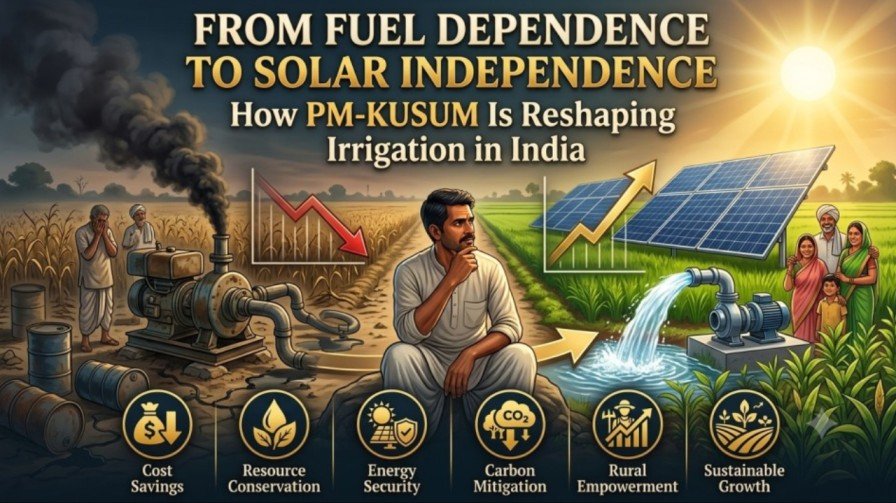
The Irrigation Challenge Before Solar Power
Any change begins when an existing system fails to cope with its challenges.
Thank you for reading this post, don't forget to subscribe!Indian agriculture was dependent on just one device, without which plants would simply cease to live: the irrigation pump. Even though seeds, fertilizers, and farming practices changed and developed, the technology that allowed extracting water from the ground was always the key to agricultural efficiency. Everything depended on the single condition: whether farmers could get access to the necessary amount of energy needed for powering their pumps.
For many farmers in India, it wasn’t always the case.
Electricity supply was unstable and was provided only during a limited period of time every day, sometimes even at night or in the early morning hours. Farmers were forced to change their irrigation time schedule depending on when there was electricity available rather than on what the needs of their crops were. Other farmers used pumps powered by diesel engines, which meant additional expenses for each irrigation.
Though there was ample access to groundwater throughout the country, efficient extraction was still one of the major problems. Irrigation not only entailed access to water but also access to reliable and cheap energy sources.
Prior to the introduction of PM-KUSUM in 2019, India was utilizing around 3 crore agricultural irrigation pumps in total. Out of which 2.2 crore (73%) pumps used the electricity source, while 80 lakh (27%) pumps relied on the diesel source. Although India is endowed with abundant potential for solar energy generation, the number of solar irrigation pumps is still minuscule when compared to the installed pumps in the country. The use of such solar pumps was limited to demonstration projects and pilot projects only.
From an initial impression, grid-connected electrical pumps seemed like a cheap solution due to the subsidy provided on electricity for agriculture. But the reality in the field was quite contrary.
Power infrastructure across rural India struggled to meet growing demand. Frequent voltage fluctuations, unexpected outages, and prolonged power cuts regularly interrupted irrigation during critical stages of crop growth. In many villages, electricity was supplied for only three or four hours a day, often at inconvenient times during the night. Rather than watering crops when required, farmers irrigated whenever electricity became available.
The consequences extended well beyond inconvenience.
According to the World Bank, inconsistent electricity supply prevented farmers from planning irrigation schedules effectively, discouraged long-term investment in agriculture and made crop planning increasingly uncertain. Instead of supporting agricultural growth, unreliable power became another factor limiting productivity and reducing farm income.
The condition of rural electricity infrastructure only made matters worse.
Agricultural transformers frequently operated under excessive loads and often suffered breakdowns during peak irrigation periods. Repair work could take anywhere from four to ten days, leaving farmers without a dependable source of power during crucial phases of cultivation. In several parts of the country, electricity with normal voltage levels was available for only 20% to 40% of the time.
Whenever there was a problem with the electricity supply, farmers relied on diesel pumps.
Diesel pumps did not depend on the electricity grid as the electric pumps did. Yet the reliance on diesel pumps carried huge economic costs. Every liter of diesel meant additional costs for irrigation, and with rising diesel prices, it became increasingly costly to grow crops. What had begun as a contingency plan eventually turned into an operational expense for farmers.
This system created ripple effects for more than just farms.
The government had to pay for the electricity subsidies out of its own budget, whereas power distribution companies faced losses due to the subsidized agriculture tariff, technical losses, and unmetered consumption of electricity. In addition, electricity subsidies led to over-exploitation of water resources in several states in the country, which further raised questions about the sustainability of Indian agriculture in the future.
By the end of the decade, it was clear that India’s irrigation system was not able to cater to the needs of the future anymore.
A reliable source of energy was necessary, which could provide stability. There was a need for governments to cut down electricity subsidy costs. There were financial sustainability requirements from power companies. The most important part was that there was a requirement for a long-lasting irrigation system for agriculture in India.
It was not a matter of whether change was necessary.
The real issue was how the new generation of agricultural irrigation would be.
It was finally provided in 2019 in the form of one of the most advanced renewable energy projects in India for agriculture – PM-KUSUM.
PM-KUSUM: A Policy That Transformed Agricultural Energy
Instead of implementing incremental improvements in an existing system, the Government of India opted to think beyond conventional means of providing energy to irrigation.
It was not about providing reliable energy or mitigating the rising cost of diesel, but about farmers needing a reliable energy supply, governments struggling with the rising costs of subsidies, and India needing a clean way forward on irrigation. These issues needed a solution in the form of not just a support scheme but a policy that transformed the dynamics of agriculture and energy.
This vision crystallized in the form of the PM-KUSUM policy, which got approval from the Government of India on 19 February 2019.
Although the scheme is commonly known for solar pumps, its scope goes far beyond that. The scheme was intended to increase irrigation, energy security, the income of farmers, and renewable energy.
Making Solar Energy Work for Farmers
The logic behind PM-KUSUM was pretty simple.
The country gets plenty of sunlight for most parts of the year, which makes solar energy one of the most easily accessible natural resources in India. Since the resource was already at hand, there wasn’t much need for the farmers to continue relying on expensive diesel or electricity that was prone to disruption in order to irrigate their lands.
So, the program aimed at allowing farmers to create their own energy.
If farmers had diesel pumps, PM-KUSUM promoted switching to solar pumps. Farmers who had access to electricity grid were provided an option to make their pumps solar-powered and thus become less reliant on unstable electricity supply. Farmers didn’t have to plan farming depending on electricity availability but could irrigate their fields when the actual situation required it.
Overcoming the Biggest Obstacle: Costs
Despite obvious benefits of solar pumps in the long run, their high installation costs became a barrier to their wide adoption, especially among small-scale farmers.
PM-KUSUM solved this problem by adopting a joint financing approach.
With regard to this initiative, both the Central and State Governments will take up a major part of the installation charges, whereas the remaining small portion of the charge will be borne by the farmers themselves. This arrangement ensures that solar irrigation is possible even for those millions of agricultural families who would not have been able to afford it without subsidies.
It was now possible for the farmers to have a solar irrigation system without being excessively burdened financially.
Making the Irrigation System An Earning System
What stands out as one of the most revolutionary features of PM-KUSUM is the way in which it enables the farmer to become both a consumer and producer of energy through the irrigation process.
The farmers with grid connected pumps can produce solar power not just for irrigation but also sell any excess solar power to the respective power distributor of the area under Component C of the programme.
Solar Power Balance and Water Conservation
Any expansion in access to solar power must not result in unnecessary exploitation of groundwater. Understanding this challenge, the policy of PM-KUSUM includes sustainability considerations in its framework.
The use of standalone solar pumps is not allowed in groundwater-scarce zones. Rather than that, emphasis is put on the conversion of diesel pumps to solar and the solarization of existing electric pumps. Alongside, micro-irrigation techniques are used, which ensure better utilization of water.
What needs to be achieved through this is quite clear – clean energy must be used for sustainable farming without further strain on groundwater sources.
PM-KUSUM: Three Components of a Unified Approach
To be able to achieve its objectives, PM-KUSUM was built on three main components.
Under component A, decentralized solar power plants would provide clean energy to local distributors.
Component B helps to install standalone solar pumps, especially those which operate in areas without grid connection, and hence have been using diesel pumps for irrigation purposes before.
Component C allows solarization of existing agricultural grid-connected pumps. Thus, the farmers get their own electricity and can supply the excess electricity to grid as well.
Combined together, these three elements made PM-KUSUM far more than just a subsidies scheme. The program offered an integrated solution combining renewable energy and agriculture, with reduced use of diesel, relief for the electricity grid and improved economics for farmers.
Backed by more than ₹34,000 crore in funding, PM-KUSUM aimed at developing one of the largest renewable energy programs focused specifically on agriculture in the world.
It was not enough to develop a plan to replace diesel pumps.
The ultimate goal of the project was to develop a model that would be able to create a framework for cleaner, more sustainable, and reliable irrigation for millions of farmers in India.
The True Test of Success
Good policy creates momentum, but it cannot guarantee success itself.
For any successful transition to occur, farmers have to get something better from switching to solar pumps.
Not only in terms of the paper, but in reality. It was not important if the solar pump sounded good on paper. It had to actually work better than conventional diesel and electric pumps.
Solar Pumps and the Transforming Economics of Irrigation
A government policy may promote the adoption of a technology, but the continued success of the innovation rests on the practical benefits it offers to users.
Farmers used to have restricted options for energy use in the case of irrigation pumps. They could opt to use diesel pump sets and pay for the increasing cost of fuel, or use electrical power, which was sometimes erratic and supplied in certain hours. Both methods posed problems and made irrigations more complicated.
Solar pumps offer a new perspective.
Unlike the above two types of pumps, solar pumps generate electricity from sunlight, and not from any other source of power. The change appears trivial at first glance, but it has resulted in several consequences in terms of agricultural productivity and operating costs.
Beyond Diesel Pumps and Electrical Power Supply Schedules
One of the most important aspects of using solar pumps is their autonomy from any conventional sources of power.
The use of diesel pumps for irrigation requires the farmer to keep spending on fuel. Each cycle of irrigation increases the costs of farming by making the user dependent on changes in the price of diesel.
Such systems solve all these problems.
With local production of energy, farmers have an opportunity to use the reliable source of power for irrigation throughout the day irrespective of the fuel supply and the electricity supply situation. The process is not dependent anymore on any external factors, but on the needs of crops.
In this way, farmers get more freedom regarding timing of water application.
From Continuous Costs to Cost Savings
It is possible to see the financial advantages of using solar pumps for irrigation in the long-term period.
The traditional method presupposes continuous spending of money on energy. If one uses diesel pump, he/she should buy fuel regularly, and electric pump is always dependent on tariffs and electricity availability. These costs are going on every year.
The situation changes with solar pumps.
While the installation of such a system is expensive, the following operation is not accompanied by additional costs. Maintenance and fuel are not required. In the end, the amount of savings may cover the initial expenses.
With advancements in solar technology and decreasing costs of equipment, the economics of using solar energy for irrigation have become more favorable. Efficiency improvements, better design of the system and large-scale manufacturing are some factors that have made solar energy feasible economically for more and more farmers.
Increasing Reliability in the Field
Apart from reduced costs, reliability is one more important factor driving adoption of solar energy for irrigation.
Modern systems designed for solar pumping can work effectively for many years with proper maintenance. Farmers don’t have to wait for the arrival of electricity at night or change the irrigation schedule due to possible unexpected power outages.
Thus, farmers get more control over their agricultural activities.
The water can be provided to crops when they need it and not when there is electricity available. Thus, farmers have more information about what crops to plant, how often to irrigate and when to cultivate them.
Supporting a Greener Agricultural Future
The environmental benefit associated with solar irrigation is just as great.
Any replacement of a diesel-powered system with solar pumping results in reduced usage of fuel and reduced greenhouse emissions. Taking into account the huge amount of diesel pumps used traditionally in India, the overall benefit to the environment will be considerable.
On a national level, solar irrigation could be one of the most viable ways to reduce the carbon footprint of Indian agriculture along with its decreased reliance on fossil fuel sources.
The shift makes sense in terms of renewable energy goals without reducing agricultural output.
Why Only Solar Pumps Won’t Do
Though solar energy provides a solution to one of the key challenges, there is more to sustainability than using only solar technology.
Solar pump produces the greatest results when used with other irrigation methods like drip irrigation, water storage facilities and water management. Replacing the energy source is not enough to ensure sustainable agriculture.
Water resources must be used responsibly alongside renewable energy.
Recognising this, PM-KUSUM promotes solarisation in a manner that supports groundwater conservation and encourages efficient irrigation methods. The objective is to ensure that increased access to clean energy does not lead to excessive water extraction.
Change That Goes Beyond Technology
Solar irrigation is more than just the use of new technology replacing the previous one.
This is an illustration of the slow change from an agricultural production system that is based on regular payment for fuels as well as electricity to one which runs on renewable energy and sustainability.
In the wake of the adoption process across various states, this transition started having effects that go beyond individual farms.
What was once seen as a means of irrigation was now providing scope within the manufacturing process as well as renewable energy infrastructure and more. PM-KUSUM was not confined to agriculture any longer.
How PM-KUSUM Has Unleashed a Whole Industry
Several years after PM-KUSUM, the discourse on solar pumps started to shift.
In the early days, discussions revolved around the acceptance of the technology by farmers. With time, a new challenge emerged: whether the industry would be able to produce and install sufficient solar pumps to cater to this growing need.
The figures below prove just how fast this market has been changing.
Before PM-KUSUM was rolled out in 2019, the Indian pump industry was already valued at ₹15,240 crore. But despite that, the contribution of solar pumps was limited to around ₹170 crore, which made them a minor part of the market.
Six years later, the pump industry in India was estimated at ₹38,050 crore with nearly ₹16,450 crore coming from solar pumps. In other words, the share of solar pumps has grown from being almost negligible to 43% in just six years.
By FY30, industry experts forecast this share to increase even further to 46%–57%, showing that solar-powered irrigation is becoming one of the largest segments of India’s pump market.
This trend is not driven by a single governmental initiative anymore; it’s an industry revolution.
Manufacturers Making the Change
While policy can help deploy solar pumps, manufacturing capability, effective logistics, implementation, and after-sales services are all equally critical.
Of the manufacturers driving the change, Shakti Pumps and Oswal Pumps have clearly become the leaders in the context of PM-KUSUM. Combined, they are responsible for more than half of the projects in the program, and hence have played an important role in the solar irrigation journey of India.
Such leadership is not just about winning government tenders.
The manufacturers have made significant investments in manufacturing facilities, product integration, and distribution networks to cope with growing deployments.
Oswal Pumps has created an extremely integrated manufacturing network, manufacturing most of its major components like pumps, motors, controllers, mountings, and even solar modules internally. This helps in maintaining quality and delivery schedules as well as in reducing dependency on third-party suppliers.
Shakti Pumps has followed a similar model and taken things one step ahead by investing over ₹1,200 crores into developing solar cell and module manufacturing capabilities within the country.
Execution matters no less.
Deployment of solar pumps in India’s varied agricultural terrain needs robust distribution, installation expertise, service centers and robust after-sales services. Through many years, both companies have developed excellent execution capabilities in key agricultural states like Maharashtra, Rajasthan, Haryana, Uttar Pradesh and Madhya Pradesh.
The proof lies in the performance.
Shakti Pumps has commissioned in excess of 1.5 lakh solar pumps under the PM-KUSUM scheme and enjoys a market share of 25%. Oswal Pumps has deployed more than 1 lakh solar pumps and turnkey solar pumping systems and enjoys an estimated lifetime market share of 31% under the PM-KUSUM and other state programs.
Future expectations from the industry are very high.
Discussions on PM-KUSUM 2.0 seem to imply that 20-30 lakh agricultural pumps may be deployed/solarized in the coming years. Phase two will also make the process more streamlined and efficient.
The optimism exhibited by the industry leaders can be seen as the best predictor of growth ahead. It would be highly unlikely for companies to invest thousands of crores worth of money in expanding their capacity unless they expect strong demand from the market to continue into the coming years.
The True Value Goes Well Beyond Irrigation
The importance of PM KUSUM goes way beyond just substituting the diesel pumps.
Each deployment of a system involves an entire network of players such as the manufacturers, EPC contractors, financing agencies, installing parties, maintenance firms and remote monitoring solutions. Collectively, these players have turned what was originally intended as a subsidies-based program into a driver of economic development in the rural areas.
One of the important contributors to this success was affordability.
Thanks to cost-sharing arrangements between the Central Government, State Governments and the farmers themselves, PM KUSUM made this solar irrigation affordable to millions of farming families. In several states, additional subsidies from the government reduced the portion payable by the farmers even more.
On the other hand, the project teaches another crucial lesson.
Sustainable agriculture is not achievable by clean energy alone. Responsible groundwater use, efficient irrigation methods and effective policy implementation are still necessary in order to achieve sustainable results.
Reviewing past experience, the success of India cannot be viewed merely in switching from diesel to solar-powered pumping stations.
India has started to replace its existing model of irrigation based on the cost of fuel and inconsistent electricity with the one based on renewable energy, local production, and value creation.
For farmers, solar pumps are more independent in terms of energy consumption, more efficient, and more reliable as an irrigation source.
For businesses, investment opportunities go beyond manufacturers of pumps and include suppliers of solar energy solutions, EPC contractors, financiers, service companies, and IT.
And for policymakers, the example of the PM-KUSUM project shows that a properly designed government program not only solves an urgent problem but creates conditions for developing a new industry.
The first stage showed the potential of solar-powered irrigation at the national level.
The next phase will determine whether India can build one of the world’s most resilient rural clean-energy ecosystems, creating lasting value for agriculture, industry and the economy alike.
Investment opportunities usually surface much earlier than they appear evident. At Strategic Alpha, we assist investors in spotting these trends through comprehensive fundamental analysis. Be part of The Conviction Club, where you can belong to a group of people who invest based on information rather than speculation.
If you need guidance on how to start your stock market journey, how much capital is enough to begin with, how to do smart investing, or how to take informed stock market decisions, you can join Strategic Alpha’s ‘The Conviction Club’. This is a membership program, especially curated to help investors become aware and knowledgeable about stock market trends, news, and technical aspects, so that they can become their own experts.
Our YouTube channel, weekly webinars, and digital resources available on the website can help you learn the basics of the stock market. For regular updates on trends, one-to-one sessions with experts, and detailed learning modules, you can join the Conviction Club, which is the online community of like-minded investors sharing knowledge and thoughts to grow together.
Subscribe to the Strategic Alpha Newsletter now to get the latest updates about weekly webinars.
Join Me On My Telegram Channel Where I Share Much More Value Adding Knowledge Of Investing/ Trading: Click Here
Also, Don’t Forget To Follow Us On Our Social Media Accounts:
Facebook: https://www.facebook.com/strategicalpha/
Instagram: https://www.instagram.com/strategicalpha/
Twitter: https://twitter.com/suyog_dhavan
YouTube: https://bit.ly/2IIqztO
Disclaimer: Strategic Alpha and Suyog Dhavan are not SEBI-registered investment advisor. The content provided is purely for educational purposes and should not be construed as financial or investment advice. Viewers are encouraged to conduct their own research or consult with a SEBI-registered professional before making any investment decisions.